You are reviewing a cable schedule and notice that one proposed cable has no armour. Is something missing, or is that simply the construction the route needs?
It is a fair question. Armour is easy to recognise in a product drawing, so its absence can feel like a compromise. But choosing a cable starts with the circuit and its surroundings. Tengyuetong’s YJLHV (TC90) is a useful example: the company lists it as a non-armoured aluminum alloy power cable. Understanding that construction helps you ask better questions before deciding whether it belongs in your project.
First, get familiar with the construction
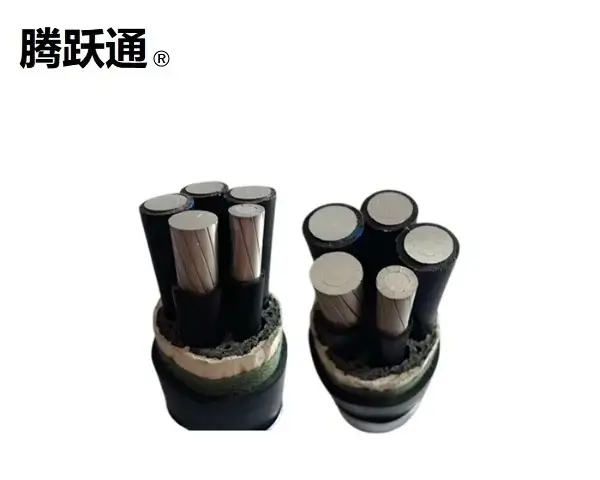
The YJLHV (TC90) product page describes rare-earth aluminum alloy conductors, XLPE insulation, and a black PVC outer sheath. There is no metal armour layer in that listed construction.
Those details describe different parts of the cable. The conductor carries current, the insulation surrounds the conductors, and the sheath forms the outer covering. Keeping the terms separate makes a supplier’s description easier to follow.
It also prevents a common misunderstanding: a black outer sheath does not tell you whether a cable is armoured. Two products can look similar from the outside while having different layers beneath the surface. Check the construction description or cross-section rather than relying on a photograph alone.
Look closely at the protection along the route
Consider a cable running through an indoor service area. Much of the route may already be protected, but that does not describe every part of the run. What happens where it enters equipment? Does it pass through an exposed area? Could later maintenance work bring tools or machinery close to it?
These questions help the designer assess the route. They do not automatically rule TC90 in or out.
Tengyuetong’s listing describes several laying arrangements and notes limitations concerning external mechanical forces. Read those points together. Ask how the proposed cable will be protected at vulnerable sections, and have the project designer confirm whether the complete arrangement is suitable.
Treat the sheath as a separate choice
The standard YJLHV description refers to a PVC sheath. The product page also discusses other constructions available on request, including options related to smoke and fire performance.
That distinction matters. An optional construction is not automatically included in a quotation for the basic model. If your project specifies a particular sheath material or performance classification, give the supplier the exact requirement.
Ask a simple question: “Which version are you proposing, and which document describes it?” The answer should connect the model designation, construction, and supporting information. Avoid assuming that every feature mentioned on a product page applies to every version sold under that product family.
Check the awkward sections before the easy ones
Long, straight sections are usually easy to describe. The useful conversations often concern the parts around them: a restricted equipment entry, a change in level, or a section that passes between different environments.
Bring those details to the installation team early. Ask whether the proposed outside diameter fits the available space and what handling information they need from the supplier. Where bending or pulling requirements matter, use the instructions for the actual cable being supplied.
This is also the time to discuss changes to the route. A cable selected for one arrangement should be reviewed if the installation plan changes. Moving a section into a more exposed location can raise questions that were not part of the original selection.
Keep electrical selection in the discussion
It is easy to spend the whole conversation talking about armour and forget the circuit itself. A suitable protective arrangement does not settle conductor sizing, voltage drop, or the other electrical requirements of the installation.
Use the design information prepared for the project. The engineer should review the selected conductor material, cross-sectional area, loading, installation conditions, and accessories together.
The same applies if TC90 is being considered as a replacement for another cable. A familiar size or similar-looking sheath does not establish equivalence. Ask what has changed in the proposed construction and have those differences reviewed before treating the cables as interchangeable.
Ask for a recommendation you can trace
When approaching an Aluminum Alloy Power Cable Supplier, describe the job as clearly as you describe the cable. Include the circuit specification, route information, environmental conditions, and any required sheath characteristics.
For YJLHV (TC90), ask Tengyuetong to identify the proposed configuration and provide its matching datasheet. If the supplier suggests a different version, ask what requirement prompted that suggestion. A clear explanation gives your designer something useful to assess.
Keep the approved specification and route notes together. Before ordering, make sure the designer, supplier, and installer are discussing the same construction and protective arrangement. Resolve questions about exposed sections or changes in protection while the selection can still be reviewed.