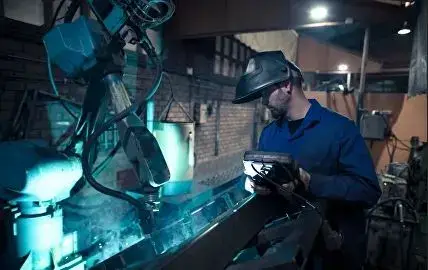
Staffing shortages have become one of the key problems of modern industry, so the integration of industrial robots is now considered by many enterprises not as an experiment, but as a practical tool to increase the sustainability of production. Companies are increasingly facing difficulties in finding qualified specialists, increasing the burden on existing staff and the need to increase production volumes.
The problem of staff shortage affects almost all industries. It is especially acute in areas where the same type of heavy or potentially dangerous operations are required. It is becoming increasingly difficult to find experienced welders, production line operators, warehouse logistics staff, or coating specialists.
At the same time, the need of enterprises for a stable production process is constantly growing. As a result, companies are starting to look for solutions that will allow them to maintain the pace of development regardless of the labor market situation.
Why is the industry facing a shortage of staff
There are several reasons for the shortage of personnel. One of the main reasons is the declining interest of young professionals in working professions. Many enterprises also face high staff turnover and a natural reduction in the number of experienced workers.
The growing demands on staff qualifications have an additional impact. Modern production is becoming more and more technologically advanced, so employees have to master new processes and equipment.
The shortage of personnel is especially noticeable in areas where work is associated with physical exertion, high responsibility or unfavorable working conditions. Such processes are often the first candidates for automation.
What tasks can be transferred to industrial robots?
Modern robotic complexes are capable of performing a wide range of production operations. At the same time, we are not talking about a complete replacement of personnel, but about a redistribution of functions and an increase in the efficiency of using human resources.
The following processes are most often robotized
- welding and metalworking;
- palletizing and packaging of products;
- application of paint and protective coatings;
- loading and unloading of equipment;
- sorting and moving items.
Performing such operations requires high repeatability of actions and stable quality of the result. It is in such tasks that industrial robots demonstrate maximum efficiency.
Liberation