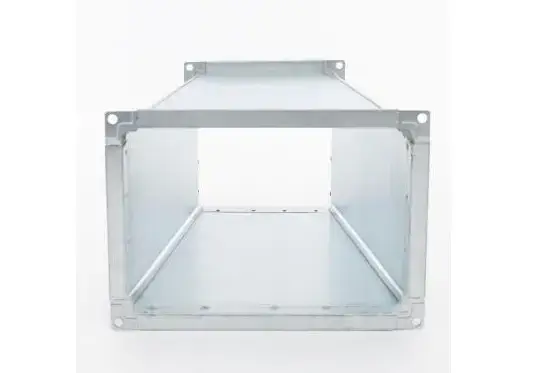
In modern air exchange systems, a special place is occupied by structures that make it possible to use space efficiently while maintaining high productivity. Such solutions are in demand in residential complexes, office centers and industrial premises, where every centimeter of the area is important. Rectangular ducts demonstrate an optimal balance between compactness and functionality, which explains their widespread use in projects of varying complexity.
"The compactness of rectangular systems allows them to be integrated into architectural solutions without compromising interior design"
Materials of manufacture and technical characteristics
The production of rectangular air ducts is carried out from several types of materials, each of which has unique properties. Galvanized steel remains the most common option due to its corrosion resistance and affordable cost. Aluminum products are chosen for facilities with high structural weight requirements, while stainless steel is used in aggressive environments such as food processing or laboratory complexes.
Example: for ventilation of an office building with an area of 2000 m2, 0.7 mm thick galvanized steel ducts with a flange connection are optimally suited — this solution ensures the tightness of the system at moderate installation costs.
Material Thickness, mm Temperature range, °C Scope of application Galvanized steel 0.5–1.2 -40 +80 Residential, office, commercial buildings Stainless steel 0.5–1.5 -60 +200 Food industry, laboratories Aluminum 0.6–1.0 -30 +100 Weight–restricted objects Plastic (PVC) 1.0-3.0 -10 +60 Domestic systems, swimming pools
Design features and types of connections
The standard length of the straight section is 1.25 meters, which simplifies logistics and installation. Two main types are used to connect the elements: flanged and nipple (flange-free). The flanged connection ensures high tightness and is recommended for systems with high noise insulation requirements. Flange-free methods, such as a rack-and-pinion connection, speed up assembly and reduce material costs.
"The choice of connection type directly affects the tightness, noise level and installation speed of the ventilation system"
Advantages of rectangular systems
The key advantage of such ducts is the efficient use of space. Due to their flat faces, they are easy to place along walls, in the interstitial space or in technical niches, where round counterparts would require a significant height margin. This is especially true indoors.