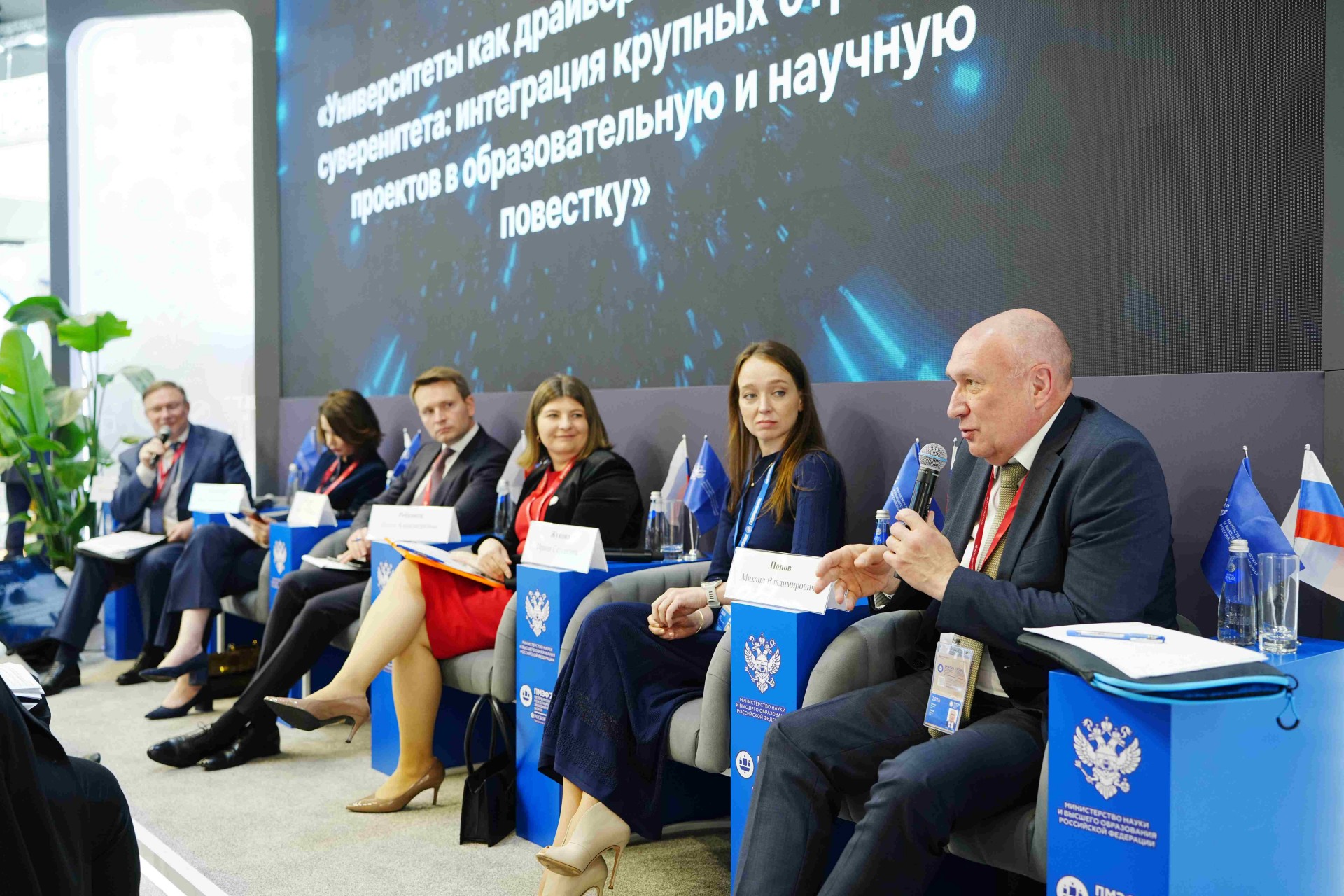
The Pipe Metallurgical Company (TMK) discussed at the St. Petersburg International Economic Forum (SPIEF-2026) the conditions for wider participation of universities in joint scientific and technological projects with industrial companies. According to Mikhail Popov, Vice President of TMK, Deputy Chairman of the Committee of the Russian Union of Industrialists and Entrepreneurs (RSPP) for scientific, educational and innovation policy, it is necessary to accelerate the training of in-demand specialists, allow universities to focus on cooperation with business, promptly form teams to solve applied problems, as well as resolve legal issues using university resources for implementation of joint initiatives.
At the session "Universities as drivers of technological sovereignty: integration of major industry projects into the educational and scientific agenda", organized by the Ministry of Science and Higher Education of the Russian Federation (Ministry of Education and Science of the Russian Federation), Mikhail Popov said that cooperation between business and universities needs, in particular, institutional and legal support. According to him, today the educational environment focuses on the horizons of personnel training in 5-10 years, which does not correspond to the pace of technology development.
"If we are talking about the participation of universities in the implementation of technological projects, then it should be here and now," he said.
Interaction is constrained by existing regulations that universities must comply with. Mikhail Popov noted that any joint project with the university is integrated into an environment that takes into account a wide range of indicators, including equipment usage parameters, academic performance assessment and other standards. This prevents the group from focusing on a specific project that is important to the business.
"If we are talking about technological leadership projects, then the university should be a full participant in them, giving them priority," said the Vice President of TMK.
He also noted an effective example of the creation of a team at Ural Federal University (UrFU) that deals with specific applied tasks.
"The university should be allowed to quickly change any structure of educational, educational, scientific units for specific tasks. It's good if we can build a similar system for other technological projects that are vital to us today," Mikhail Popov said.
Another factor that hinders effective cooperation is the lack of a common legislative framework governing, in particular, the use of university resources and equipment for the implementation of joint projects.
"We need uniform rules, and then universities will cooperate more actively.