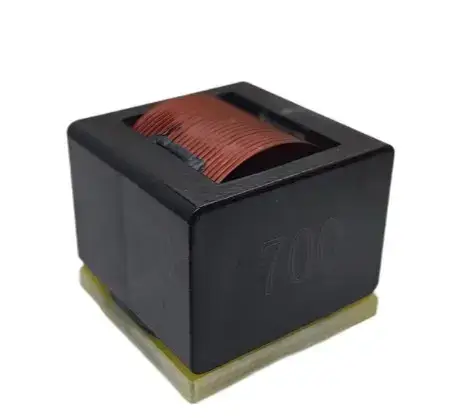
A high-current inductor is easy to compare on paper.
One part may be described as 75A, another with a higher current figure. The larger number can look safer, but current rating alone says very little about how the component will behave inside a real converter.
For power designers, the more useful questions are how much inductance remains under DC bias, how much copper loss is generated, and whether the core approaches saturation during peak-current conditions.
TrafoPSU’s Custom High Current Inductor 12uH-75A is part of a high-current series using options such as flat-wire winding and alloy-powder construction. The product is positioned for applications including DC-DC converters, EV charging, solar inverters, energy storage, industrial SMPS and motor drives.
In those circuits, DCR quickly becomes a thermal issue.
At high current, even a small resistance creates meaningful copper loss. That heat raises winding temperature, which increases resistance again and reduces the thermal margin available to the rest of the power stage.
This is why I would not approve an inductor from room-temperature inductance alone.
The prototype should be checked at the expected RMS current, peak current and ambient temperature. If the converter operates with significant ripple current, the peak condition also needs attention because it can push the magnetic core closer to saturation.
For any high-current inductor, the designer should check how much inductance is retained under the expected DC-bias condition rather than relying only on the nominal value.
Any reduction in inductance under bias changes ripple current and should be included in the converter design margin.
Mechanical construction affects thermal behavior as well.
Flat-wire windings can help reduce DC resistance and make better use of the available winding window, but spacing, core geometry and heat removal still need to match the PCB and enclosure. Thermal testing should be repeated in the real enclosure, where nearby power components and restricted airflow may raise the inductor temperature well above an open-bench result.
The wider TrafoPSU product range includes custom transformers, inductors, common-mode chokes and nanocrystalline magnetic components for high-power electronics.
For a custom high current inductor, I would define inductance, peak current, RMS current, allowable temperature rise, DCR target and mechanical envelope before discussing final construction. Those numbers give the magnetics supplier enough information to design for the circuit rather than simply matching a catalogue current rating.