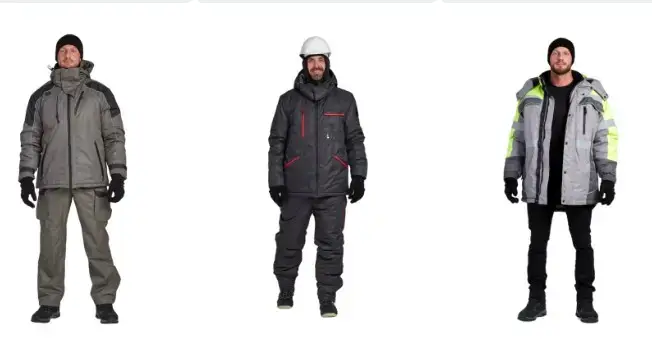
In winter, working outdoors or in unheated rooms places special demands on equipment. Not only the health and safety of an employee, but also their productivity depend on how well men's winter workwear is selected. Cold, damp, and wind can cause colds, frostbite, and decreased concentration. To make the right choice, it is necessary to take into account a number of important criteria, and not just focus on the final price. This is especially true for companies that plan to purchase workwear in bulk. In this guide, we will look in detail at what to look for when buying.
The main criteria for choosing winter workwear
Choosing winter work clothes is not just about finding the warmest jacket. This is a comprehensive assessment, where each element plays a role.
Climatic conditions and temperature regime
The first place to start is to determine the conditions in which the clothes will be used. Will it be a dry frost or wet, windy weather? Manufacturers often specify the temperature range for which the model is intended. For example, medium-density insulation is suitable for operation at temperatures from -5 to -20 °C, and clothing with reinforced filler is required for extreme frosts below -30 °C. Also consider the level of physical activity of the employee. With a high level of movement, the body generates more heat, and clothing that is too warm can lead to overheating and subsequent hypothermia due to moisture from perspiration.
Upper material: protection from wind, water and fire
The external material is the first barrier in the way of bad weather.
- Water-repellent and windproof impregnation is mandatory for winter models. It prevents the fabric from getting wet from sleet and rain and protects it from the biting wind.
- For work involving sparks, open flames or high temperatures, workwear made of fire-resistant fabrics such as Oxford FR or fabrics with impregnations that prevent fire is required.
Insulation: the core of warmth
The type and density of the insulation directly depends on how warm the clothes will be.
- Synthetic insulation materials (holofiber, thermofin, sintepon, isosoft) are the most popular option. They do not absorb moisture, retain heat well even when wet, dry quickly and are hypoallergenic. Insulation density is measured in grams per square meter (g/m2). For winter, the starting density is considered to be 200-250 g/m2, for severe frosts — 300-400 g/m2.
- Natural insulation materials such as down have exceptional thermal insulation properties, but they lose them when wet and require special care. They are less often used in work clothes.