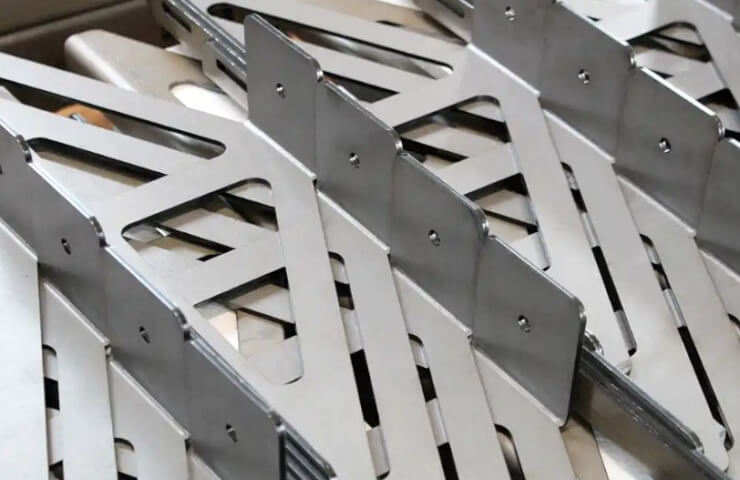
In modern metal production, laser cutting of metal occupies a dominant position among all thermal cutting methods. The reason is a unique combination of high productivity, minimal cutting width and almost complete absence of mechanical impact on the workpiece. Unlike plasma or oxygen gas cutting, a laser beam concentrates energy in a spot with a diameter of up to hundredths of a millimeter, which makes it possible to cut metal with a thermal effect on the edges of no more than 0.1–0.2 mm.
The principle of operation of the laser cutting complex is based on the generation of a coherent high-power light beam. Fiber or Co₂ lasers installed on CNC machines direct the beam through an optical system to the surface of the sheet. The metal in the impact zone is instantly heated to the melting and evaporation temperature, and an auxiliary gas (nitrogen, oxygen or compressed air) blows the melt out of the cutting zone. It is the choice of gas that determines the edge quality: when cutting with nitrogen, a clean, scale-free surface is obtained that does not require additional processing.
Laser-cutable materials cover almost the entire range of ferrous and non-ferrous metals. Structural and stainless steels, aluminum and titanium alloys, copper, brass, and bronze — each material has its own set of parameters: laser power, pulse frequency, gas pressure, and head speed. For example, stainless steel up to 3 mm thick can be cut at high speed with nitrogen, producing an edge ready for welding without stripping. But thick sheets of carbon steel require the use of oxygen, which supports the exothermic oxidation reaction and accelerates the process.
One of the key advantages of laser cutting is the ability to process complex contours without changing tools. Shaped holes, curved edges, small elements and sharp corners — all this is formed according to the control program in one pass. The accuracy of geometry reproduction reaches ± 0.05–0.1 mm, which is comparable to milling, but at a much higher speed. Laser systems are indispensable for mass production of parts with a repeating shape: sheet cutting is optimized automatically, minimizing metal waste.
The thickness of the metal being cut depends on the laser power. Modern fiber installations with a capacity of 3-6 kW confidently cut steel up to 20-25 mm, aluminum — up to 12-15 mm, stainless steel — up to 15-20 mm. More powerful systems (8-12 kW) are capable of processing steel sheets up to 40 mm thick. However, the economic feasibility of laser cutting at large thicknesses is inferior to plasma or waterjet —