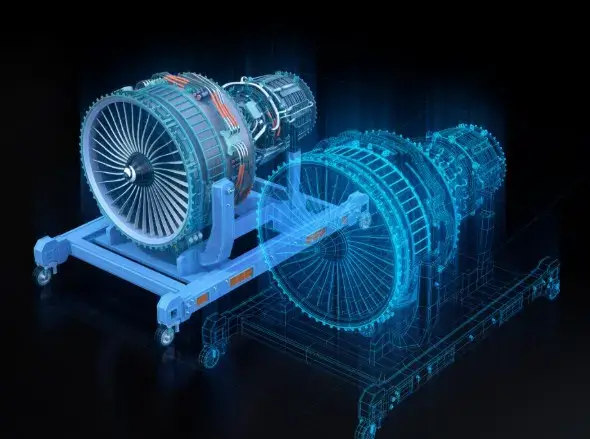
In industrial production, situations often arise when it is necessary to manufacture a part, but the design documentation is missing or lost. This may be due to the long service life of the equipment, the cessation of production of certain products, the lack of archival drawings, or the need to promptly restore the operability of the equipment. In such cases, the parts are manufactured according to a sample based on reverse engineering methods.
This approach allows you to obtain the necessary technical information directly from an existing product and use it for the subsequent production of a similar part. Reverse engineering is particularly in demand in the fields of metalworking, mechanical engineering, industrial equipment repair and spare parts production.
What data can be obtained from the finished part?
Even in the absence of drawings, the finished product contains a significant amount of information necessary for its reproduction. Modern measurement methods make it possible to determine geometric parameters, design features and surface characteristics.
In the process of examining the details, specialists can obtain the following data::
- linear dimensions and tolerances;
- the geometry of the exterior and interior surfaces;
- location of process openings;
- characteristics of threaded connections;
- seating features;
- manufacturing material;
- characteristics of heat treatment and coating.
For complex products, three-dimensional scanning methods can be used to create a digital model of an object with high accuracy. The information received becomes the basis for the preparation of design documentation and further production.
How reverse engineering helps to reproduce a product
Reverse engineering is a complex of engineering measures aimed at studying an existing part and restoring its structure. In the industrial sector, this process includes measuring a product, creating a digital model, analyzing materials, and developing a set of technical documentation.
If necessary, reverse engineering services are used, which make it possible to restore the complete set of data necessary for serial or single manufacturing of the part according to the available sample.
After receiving the digital model, engineers prepare drawings, determine the processing technology and select production methods. As a result, a product is created that best matches the original design in its geometric features.