Steel-plant walkway corrosion concentrates in local pockets—pickling lines, acid regeneration skids, scrubbers, dosing stations, and condensate drains—steps from dry aisles, radiant heat, or welding lanes. Forcing one grating material across an entire elevation causes early wear or retrofit hazards; screen thermal and hot-work limits before comparing corrosion options.
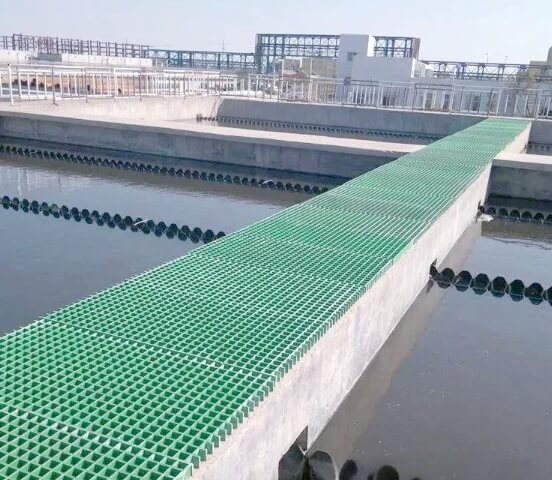
Grating walkway beside a water basin. Application illustration only.
1. Define the Local Zone First
Map where splash, mist, condensation, or washdown starts and stops rather than specifying one material across the whole platform. Screen high ambient or radiant heat, molten-metal or hot-slag splash, and frequent hot work first. FRP grating, an open fiberglass-reinforced polymer (glass-fiber-and-resin) walkway or platform grid, has finite thermal limits, and metal grating is not automatically safe in every high-heat or molten-metal exposure either—alloy grade, coating heat limits, and structural exposure still need verification.
Do not read a surface fire test as high-heat or molten-metal proof. ASTM E84-23 gives only comparative surface flame-spread and smoke-density measurements under its test conditions; a flame-spread index alone does not classify a material as noncombustible, and E84 is not a fire-resistance, molten-metal, or full fire-hazard test.
Hot work requires site controls, not a site-wide permanent ban on FRP. OSHA 29 CFR 1910.252 is a U.
S. welding, cutting, and brazing fire-prevention framework (not universal law, and not governing grinding); work must not proceed if required controls cannot be met, and where a fire watch is required, it must be maintained at least a half hour after completion under specified conditions. OSHA does not recommend a grating material; grinding follows site hot-work rules. Where frequent hot work makes shielding or panel removal impractical, verified metallic grating is usually more practical in that lane.
2. Match Chemistry and Temperature
Record exact chemicals, concentration swings, and exposure mode (splash, pooling, vapor, condensation, washdown), noting evaporation concentrates warm splashes.
Do not assume coated or galvanized carbon steel always fails rapidly in acids or chlorides, nor fits every splash zone. American Galvanizers Association guidance notes hot-dip galvanizing often performs well above pH 4.0 and below 12.5 where a protective film can form, but not as a hard rule because agitation, aeration, temperature, polarization, inhibitors, and physical form can alter rates sharply.
Stainless resistance is grade- and condition-dependent. As worldstainless guidance notes (an architecture/civil lecture aid, not a steel-plant walkway standard), higher temperature and chlorides reduce pitting resistance; PREN helps compare grades without by itself proving fitness, and tight contacts or deposits invite crevice attack.
FRP chemical and thermal performance belongs to a specific finished product and resin grade in a defined medium, exposure, load, and duration—not a resin family name. Grit tops, a covering layer, or cut edges alter chemical contact. Confirm that exact configuration from supplier or project evidence rather than generic labels or another vendor's chart.
Separate continuous temperatures from brief upsets, and never treat heat deflection temperature (HDT) as a continuous service temperature or design limit. ASTM D648-18 data must not be used to predict plastic behavior at elevated temperatures unless time, temperature, method of loading, and fiber stress are similar to the test; the data are not intended for design or for predicting endurance at elevated temperatures. Sustained loads add creep, and metallic walkways still require checking alloy and coating heat limits.
Table 1. Conditional Comparison of Walkway Grating Options (Not a Ranking)
3. Structural Fit and Retrofit Checks
Panel thickness or mass is not a load rating, and engineers should not assume one grating type swaps one-for-one at the same depth on existing spans. Verify real product load-span tables for load type, span definition, deflection limit, and bar direction (pultruded bearing bars must span supports), and check impact or dropped-tool duty across candidates. Inspect existing framing for hidden corrosion first, then confirm bearing seats, depth transitions, cutout support or banding, and supplier checks for treating or sealing cut FRP edges.
Square-mesh grating samples showing panel geometry. Appearance only; not evidence of slip resistance, load capacity or installation method.