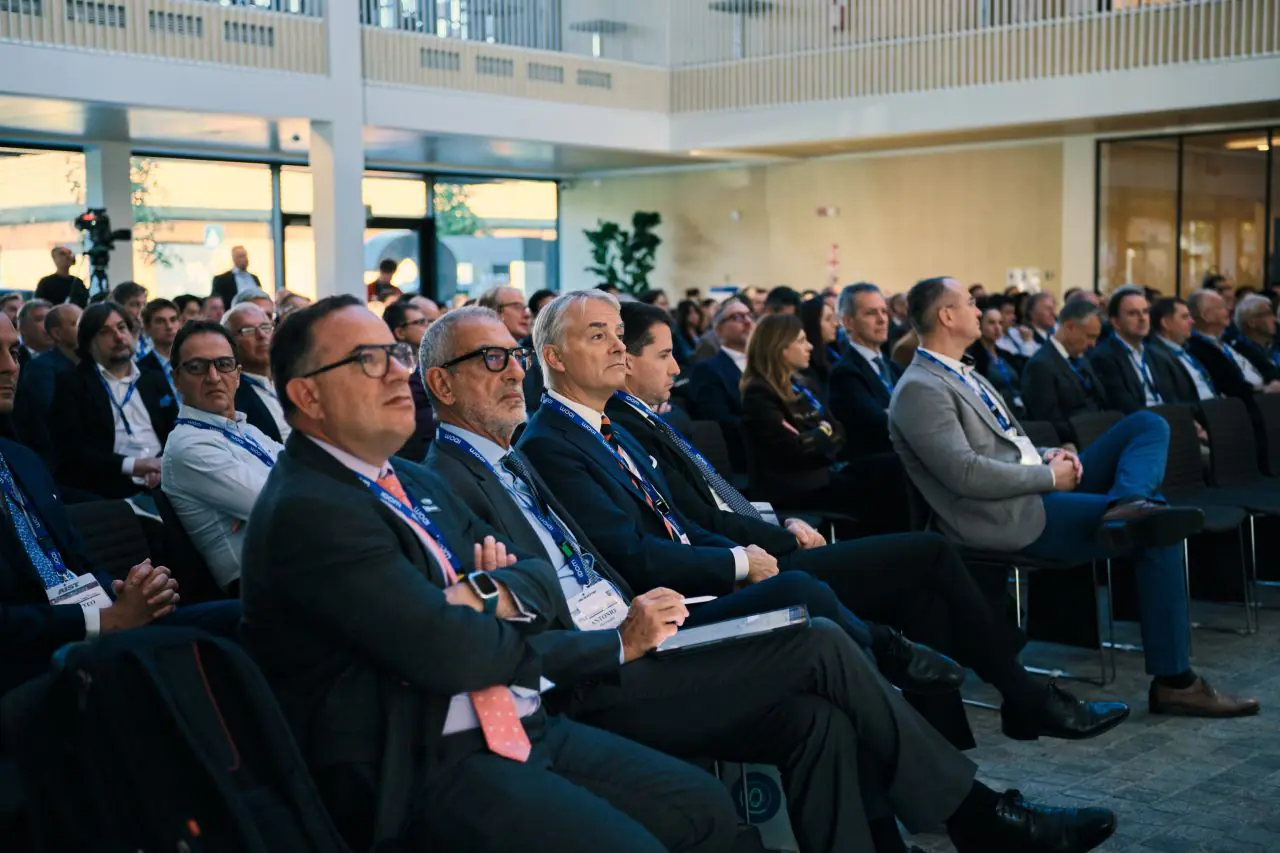
The second day of the European Steel Forum, organized by AIST (the Association for Iron & Steel Technology) in partnership with Danieli in Udine on October 27–28, opened with a discussion among industry leaders. Participants included Marco Di Giacomo, CEO of Acciaierie Bertoli Safau S.p.A.; Jean Arrib, group technical director and steelmaking expert at ArcelorMittal Luxembourg; and Yuri Krotov, vice president of long products at Steel Dynamics, Inc. The discussion was moderated by John Ball of AIST.
Participants noted that the transformation of the steel industry depends on its ability to combine emissions reductions with competitiveness and resilient industrial supply chains. This will require investment in new facilities, affordable energy and raw materials, and a production base capable of meeting demand. Despite differences between the European and U.S. markets, participants identified shared priorities: strengthening supply chains, improving security, and increasing plant efficiency through innovation.
Competitiveness Depends on the Entire Production Chain
The future of Europe’s steel industry is closely linked to the prospects of the businesses that use steel. Arrib and Di Giacomo agreed on this point. They said protective measures could support the industry in the medium term, but long-term survival requires sustainable competitiveness.
“We need to understand how competitive we are compared with countries in the Middle East, Asia and India, and how to support downstream industries. If there is no basic range of these products, Europe’s manufacturing capacity will shrink,” Di Giacomo said.
Krotov offered a U.S. perspective, saying that manufacturing is once again becoming strategically important and has strong growth prospects. He also challenged the perception of steelmaking as an industry reliant on outdated methods. The ongoing adoption of new technologies and process improvements make it more dynamic than commonly assumed.
Europe and the U.S. Seek Common Ground
Trade relations between Europe and the U.S. remain complicated. Arrib believes that seeking a comprehensive political agreement right away may be too ambitious. In his view, a gradual approach based on practical steps—such as mutual recognition of certification and more harmonized standards for low-emissions steel—offers a better path forward.
Di Giacomo stressed the need to restore common ground, although the parties’ positions still differ significantly. Krotov sees a basis for cooperation in their commitment to free-market principles and their desire to preserve manufacturing supply chains and technological capabilities.
“When an economy that is not based on free trade enters the market, measures are needed to protect your own system. I believe the U.S. has a lot in common with Europe, Canada and Mexico—above all, a manufacturing and innovation base that needs to be developed,” Krotov said.
Building on shared interests could help establish a more practical dialogue on protecting each side’s industry.
Scrap Becomes a Strategic Resource
Changes in production processes are drawing greater attention to the availability of raw materials. As electric steelmaking is increasingly viewed as a way to reduce emissions, securing scrap supplies is becoming especially important. Vertical integration and expanded processing of ferrous and non-ferrous metals can help address this challenge. European governments and institutions are paying more attention to the issue, but the question of how to provide the continent’s industry with sufficient volumes of raw materials remains unresolved.
Arrib noted that the shift to new technologies is changing procurement requirements even for corporate groups with long-established traditional supply chains. Investment in mineral resources helps provide raw materials for blast furnace production, but reliable sources of the materials needed for lower-emissions processes have yet to be secured.
Energy and Infrastructure Set the Pace of the Transition
Companies’ resilience also depends on the infrastructure that supports their operations. Di Giacomo distinguished between a company’s ability to respond to disruptions and the condition of the system as a whole. Producers can prepare for outages, but their options are limited when problems affect power grids or other infrastructure.
Europe’s transition to electrification must therefore take into account electricity costs and the ability of power grids to handle changes in consumption and generation. Di Giacomo also voiced concern about how the Carbon Border Adjustment Mechanism (CBAM) could affect some ferroalloys.
Arrib said ArcelorMittal reduces risks by diversifying suppliers geographically and coordinating expertise across the group. Managing port infrastructure also helps ensure reliable delivery of products to their destinations.
Krotov outlined an energy strategy that includes long-term agreements to purchase electricity from nuclear power plants, investment in renewable energy, and projects at company facilities. This makes energy security and emissions reductions part of a single industrial planning process.
AI Helps Transfer Knowledge and Develop New Skills
Companies are at different stages of adopting artificial intelligence. Di Giacomo described AI as a tool with significant potential that ABS is still learning to use fully in decision-making and development. The company also plans to use it in analysis related to a new plant.
Arrib spoke about several ArcelorMittal pilot projects. These include chatbots that help operators troubleshoot problems and tools for searching information across the group’s resources. One of the most significant projects focuses on knowledge transfer: an AI system was trained on the experience of an employee preparing to retire so that it can help onboard younger colleagues.
Krotov noted that digitalization helps attract younger generations. Demonstrating the capabilities of AI, automation and the Internet of Things can showcase the steel industry’s technological potential. At the same time, he stressed, experimentation must be accompanied by clear rules for using new tools.
The discussion showed that transformation affects the entire industrial system. Advanced technologies create new opportunities, but their effectiveness depends on access to energy, reliable raw material supplies, developed infrastructure and a skilled workforce. For Europe, preserving a strong manufacturing chain is particularly important. Ultimately, investment in decarbonization and innovation must strengthen the industry’s ability to produce, compete and preserve jobs over the long term.
Author: SteelOrbis editorial team


