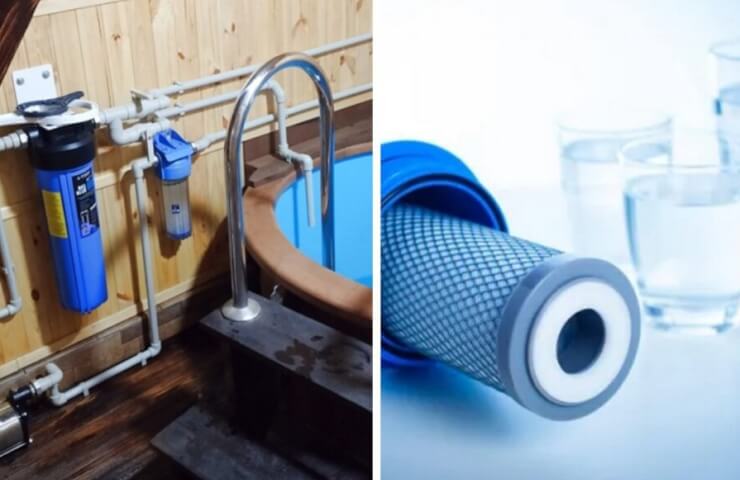
A water treatment system for the whole house must take into account not only the taste and smell of water, but also its initial quality, pressure, flow rate and the features of the internal network. An unsuitable filter clogs up quickly, reduces pressure, or fails to handle specific contaminants. To understand how to choose a main water filter, first determine which water enters the house and what tasks the system should solve. After that, you can select the cleaning sequence and the appropriate type of cartridges.
Start by analyzing the source water
The same set of filters will not be equally effective for water from the central water supply, borehole and well. In urban networks, mechanical cleaning of rust, sand and other suspensions is more often required, as well as removal of an unpleasant odor or taste. Water from an autonomous source may contain iron compounds, excess hardness salts, and other impurities that cannot be eliminated by a conventional carbon cartridge. It is advisable to submit a sample to a laboratory before purchasing the equipment. The result of the analysis helps to distinguish the problem that a standard cartridge solves from a situation that requires specialized installation. If you focus only on turbidity, scale, or odor, you can choose a filter that improves one indicator, but ignores the rest.
What filters are used in the home system?
Main filters are usually used to purify the water at the entrance to the house. They are installed in the pipeline and pass through the entire flow, which is directed to plumbing, household appliances and water intake points. The housing is selected taking into account the pipe diameter, the expected flow rate and the allowable pressure. A replaceable element is placed inside the main body. Its task depends on the material and construction.:
- mechanical cartridges trap sand, rust, scale particles and other suspensions.;
- carbon elements reduce the content of chlorine and some compounds that affect smell and taste.;
- softening cartridges work with salts, which cause scale to appear on the heating surfaces.;
- Specialized loadings are used for individual impurities, such as iron compounds, if their use corresponds to the analysis results.;
- Fine cleaning is designed to trap smaller particles, but it can have a more noticeable effect on the pressure and rate of clogging.
In practice, filters are often combined into several steps. First, a coarse mechanical cleaning element is installed, then a cartridge for dissolved impurities is used, and only after that a finer filtration is added. This sequence helps to distribute the load and not