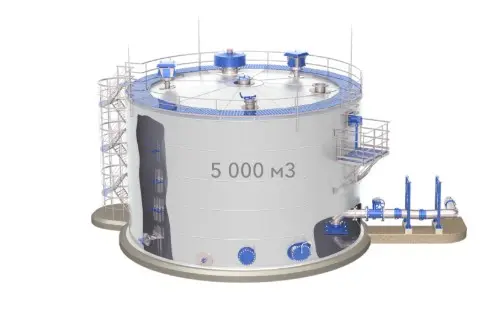
Vertical tanks intended for storing oil, petroleum products, chemicals and gases must be equipped with pipes and hatches in the roof. These elements ensure safe operation, maintenance, monitoring and emergency management of the tank.
Pipes and hatches play a key role in maintaining tightness, ventilation, filling, draining, and preventing overpressure. Their design, materials and location are strictly regulated by industry standards and safety standards.
General requirements
Materials
Pipes and hatches must be made of materials compatible with the stored medium. Carbon or stainless steel, as well as aluminum, are most often used. For aggressive media such as acids or alkalis, special coatings or alloy steels that are resistant to corrosion are used.
Tightness
All connections of pipes and hatches must be completely sealed and withstand the working pressure of the tank. Sealing elements such as gaskets and flanges must meet tightness standards.
Availability for maintenance
Hatches should provide convenient and safe access for inspection, repair and cleaning of the inner surface of the tank. The pipes should be positioned so that they can be easily connected to filling, draining, ventilation and control systems.
Pipe requirements
Purpose of the nozzles
The nozzles perform various functions depending on their purpose.:
- Filling — to supply the product to the tank.
- Draining — to remove the product from the tank.
- Ventilation — to relieve excess pressure and prevent the formation of a vacuum.
- Control and measuring devices — for the installation of level, temperature and pressure sensors.
- Emergency relief — for emergency pressure relief in emergency situations.
- Sampling rooms are used for sampling stored product.
Dimensions and location
The diameter of the nozzles is determined based on the product consumption and technological requirements. The pipes must be located at a sufficient distance from each other to avoid mutual influence. For example, the filling pipe should not be located in the immediate vicinity of the ventilation.
Design features
The nozzles are equipped with shut-off valves, such as valves or gate valves, to control the flow. Ventilation and emergency pipes