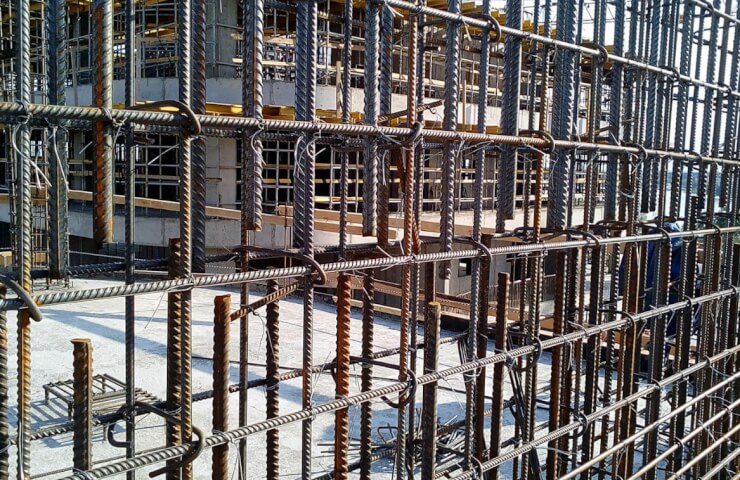
The choice of fittings is a strictly regulated engineering process. The bearing capacity, crack resistance and durability of reinforced concrete structures directly depend on the diameter and class of reinforcing rods. An erroneous decision leads either to destruction or to an unjustified rise in price. Therefore, the designer relies on the physics of reinforced concrete, the requirements of current regulations and economic feasibility.
Why is reinforcement necessary?
The reason for reinforcement is the fundamental difference between the properties of concrete and steel. Concrete resists compression perfectly, but is extremely weak when stretched and bent (the tensile strength is about ten times lower than the compressive strength). Steel reinforcement perceives the tensile forces, compensating for the weakness of the concrete. The joint work of materials is possible only with reliable adhesion. That is why the working fittings always have a periodic profile (grooving).: The protrusions provide mechanical anchoring and multiply the contact area with concrete. Smooth reinforcement is devoid of such adhesion and should not be used to perceive basic tensile forces.
Reinforcement classes: regulatory framework and selection
The modern classification of steel reinforcement is based on GOST 34028-2016 and GOST R 52544-2006. The main working class in monolithic construction is the A500S. The designation stands for unambiguously: "A" — hot—rolled or thermomechanically hardened reinforcement, "500" - minimum guaranteed yield strength σT ≥ 500 N/mm2, index "C" — weldable. It is the guaranteed weldability that makes the A500C an uncontested choice for reinforcing frames and grids made by contact welding. Class A400 (formerly A-III according to GOST 5781-82) has a yield strength of 400 N/mm2, but does not have a C index; its welding without special chemical composition leads to embrittlement of the metal and the appearance of weak nodes. In modern construction, the A400 is considered obsolete for load-bearing structures.
Smooth reinforcement of class A240 (yield strength ≥240 N/mm2) is used exclusively as mounting and transverse (clamps, spirals), where the main task is to fix the rods and prevent buckling, and adhesion to concrete is not critical. An attempt to use the A240 as a working stretched armature leads to loss of grip and sudden destruction of the element.
Composite polymer reinforcement: a limited application area
Composite polymer reinforcement (KPA) is regulated by SP 295.1325800.2017 and GOST 31938-2012. Its main advantages are its absolute corrosion resistance and low weight. These qualities are in demand in road construction.