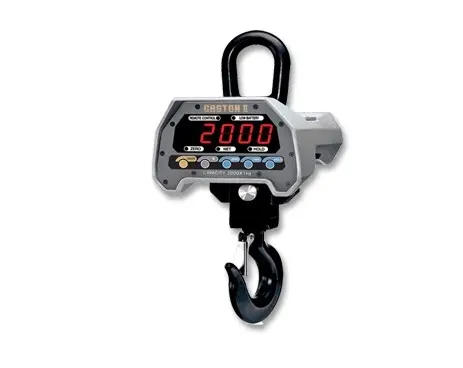
At production sites, metal warehouses, and shipping areas, it is often necessary to work with loads that cannot be conveniently weighed on conventional floor or platform scales. These are beams, sheet metal, pipes, coils, billets, containers, large assemblies and other heavy products. In such conditions, it is important not only to lift and move the cargo, but also to accurately understand its mass before it is put into operation, stored or shipped.
One of the practical ways to control is to weigh the load in a suspended state. For this purpose, crane scales are used, which are installed between the lifting mechanism and the lifting device. This approach allows you to measure the mass directly during lifting, without a separate platform for stationary scales and without unnecessary movements around the warehouse.
Where crane scales are used
Crane scales are in demand where cargo is already being moved by crane, hoist, beam or other lifting equipment. They are most often used in metal depots, in procurement workshops, at production sites, warehouses of heavy products and in areas where raw materials are accepted.
For example, when shipping rolled metal, it is important to quickly check the actual weight of the batch. If the load is already suspended on a hook, it can be weighed without being transferred to the platform. This saves time and reduces the number of operations with heavy products.
In production, crane scales help to control the mass of workpieces, parts and assemblies before being transferred to the next site. This is especially useful if the mass affects the technological process, the completeness of the batch, or the accounting of materials.
Why are platform scales not always enough?
Platform scales are well suited for pallets, crates, containers and loads that can be safely placed on the platform. But there may be difficulties with long or non-standard cargo. Metal beams, pipes, sheets, or large welded structures are not always convenient to place on a platform. Sometimes this requires additional equipment, a free site, and the participation of several employees.
Crane scales solve a different problem. They allow you to weigh the load at the moment of lifting, when it is already on the slings, traverse or other gripper. This is especially useful when working with heavy and bulky products, where each additional movement increases the operating time and the risk of damage to the cargo.
What is important to consider when choosing
The first parameter is the maximum weighing limit. The scales must have a load margin. If the typical weight of the load is close to the upper limit, the equipment will operate in a more severe mode. Therefore, it is better to choose a model with a reasonable margin for regular operation.
The second parameter is the discreteness, that is, the step of the readings.