Compressed air and industrial gases are used in almost any industrial enterprise — in metallurgy, mechanical engineering, chemistry, glass production and in the food industry. And one of the parameters that directly affects product quality and equipment reliability, but often remains without proper control, is the humidity of the gas. Excessive moisture in the main line leads to corrosion of pipelines, freezing of lines during the cold period, failures of pneumatics and defective products. In industries with strict environmental requirements, uncontrolled humidity results in direct losses.
Why humidity needs to be measured
The air at the compressor outlet always contains moisture. Refrigeration and adsorption drying systems reduce it, but the efficiency of the dryer decreases over time: the adsorbent is depleted, nodes wear out, and the load changes. Without constant measurement, the degradation of drying remains unnoticeable until the crude gas reaches the consumer and causes a problem. Therefore, proper operation is based not on a one—time setup, but on continuous monitoring of a key indicator - the dew point.
The dew point is the temperature at which moisture from a gas begins to condense. The lower it is, the drier the gas. For refrigerated drying, values around plus 3 degrees are sufficient, and for critical processes in pharmaceuticals, electronics, and when working with industrial gases, values up to minus 40 degrees and below are required. Compliance with the required level is set by the international standard ISO 8573-1, which classifies compressed air, including humidity.
How to measure the humidity of gases
Dew point sensors are used to control humidity. The principle of their operation is based on measuring the moisture content in the gas stream and converting it to the dew point temperature. Modern industrial sensors operate in a wide range, are pressure-resistant, and transmit data to the enterprise's monitoring system via digital interfaces, which allows continuous and automatic monitoring.
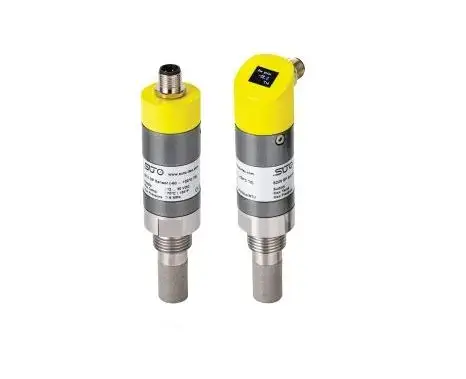
For stationary monitoring on the highway, plug-in sensors are used that constantly monitor humidity at a critical point. For example, an industrial compressed air and gas humidity sensor is used to continuously measure the dew point directly in the line and signals if the dehumidifier has stopped working. More information about the operating principle and characteristics of such devices can be found on the SUTO S211 dew point sensor page.
Monitoring at multiple points in the network
In addition to monitoring at one critical point, several sensors are installed on an extensive pneumatic network — on different sections of the main line to monitor the state of the gas from the compressor station.


