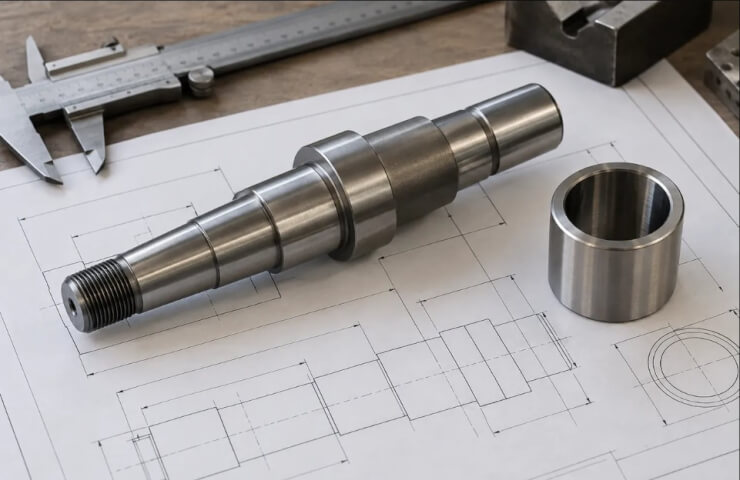
A bushing, axle, or spacer ring look like some of the simplest parts in mechanics: several diameters, a length, and a hole in the center. That is why they are often ordered based on a short sketch with the words "make it as a sample." Then it turns out that the shaft enters too freely or does not enter at all, the collar interferes with the neighboring bearing, the thread starts from the wrong side, and two parts with the same nominal diameter cannot work in the same assembly.
The turning part is related not only to the numbers on the view, but also to how it is based, rotates, transmits force, lubricates, disassembles and is checked. A good assignment doesn't have to be multi-volume. It should remove the main uncertainty: which surface interacts with what and which parameters determine the operation of the node.
You need to start with the function, not the part name.
The word "sleeve" does not indicate whether the part is a guide, spacer, bearing, threaded, or protective. The remote ring can only set the gap between the parts, and can transmit the axial force during tightening. The axis can work as a fixed finger in the bracket or rotate in the supports. This changes the critical diameters, ends, roughness, the need for chamfers and material requirements.
The useful first line of the order does not look like a "20 mm sleeve", but as a brief description of the location in the assembly: "the part is mounted on the shaft, rests against the inner ring of the bearing, is closed from the outside with a washer." This phrase does not replace a drawing, but it helps to see which questions should not be skipped. For example, an end face that transmits force cannot be described only by the total length of the part if there is a chamfer or radius on the other side.
For the axis, it is worth immediately specifying whether it rotates relative to the bushing or is stationary, whether it is fixed with a nut, locking ring, pin or welding. There is no need to invent unnecessary design details, but you can not hide the method of fixation if the presence of grooves, threads, bald spots or tool access depends on it. Otherwise, you will get a neat cylinder that cannot be physically installed.
The nominal size does not yet describe the fit
The entry "shaft 20 mm" indicates the nominal value, but does not indicate how much the actual size may differ and how it fits with the hole of the mating part. Free sliding, easy assembly, centering, pressing fit, and thermal displacement compensation require different tolerance fields and different surface conditions. It is dangerous to choose them by household analogy: even the same ratings can work differently depending on the load, contact length, material, temperature, lubrication and service cycle.
If the finished drawing uses a landing system, it must be saved without retelling.