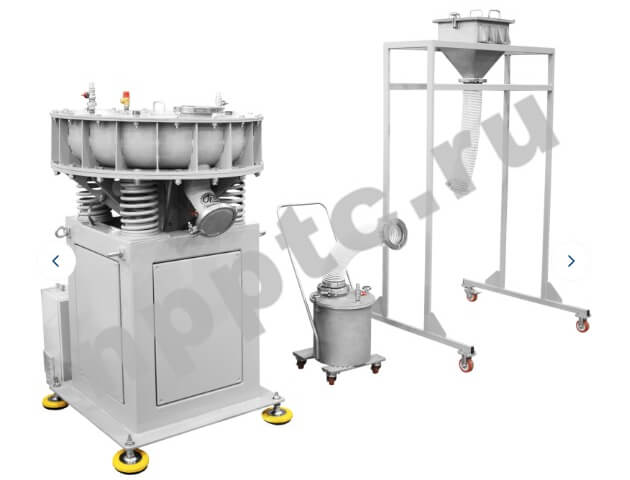
The processes of obtaining dispersed materials with specified particle parameters require equipment capable of providing intensive mechanical action with controlled energy consumption. Vibrating mills demonstrate high efficiency in fine and ultrafine grinding of mineral raw materials, chemical reagents and process powders due to a combination of impact, abrasion and shear loads.
"Vibration energy is converted into targeted destruction of the material — this is the basis for high productivity of vibrating mills"
Operating principle and design solutions
The working process of a vibrating mill is based on the transmission of high-frequency vibrations from a vibrating drive to a working chamber filled with grinding media. Vibration creates an intense movement of the grinding medium, which repeatedly affects the material, ensuring its crushing and abrasion to the required dispersion.
Example: when quartz sand is crushed to a fraction of less than 10 microns, a vibrating mill with an oscillation frequency of 1,500 rpm and an amplitude of 3 mm provides productivity of up to 200 kg/hour with a specific energy consumption of 30% lower than that of ball mills of similar capacity.
Advantages of vibration grinding
Vibrating mills provide high process intensity due to a combination of impact and abrasion effects, which allows you to achieve the required dispersion in less time compared to traditional solutions. Adjusting the frequency and amplitude of vibration makes it possible to adapt the operating mode to the characteristics of the material without replacing the tooling.
Example: when processing calcium carbonate, the operator changes the vibration frequency from 1200 to 2000 rpm to switch from grinding up to 40 microns to ultrafine grinding up to 5 microns — the changeover takes less than 10 minutes without stopping the production cycle.
"The flexibility of vibration settings allows you to optimize the process for any material without capital costs for equipment replacement"
Types of vibrating mills and applications
The equipment is classified according to the design of the working chamber: tube mills for continuous process, capacitive for periodic loading, planetary vibration for ultra-fine grinding. The choice of type is determined by the technological scheme, the required productivity and the granulometric composition of the product.
Materials of execution and wear resistance
The working chambers and grinding bodies are made of wear-resistant materials: high-manganese steel, ceramics based on aluminum oxide or zirconium, polyurethane for gentle processing. The choice of material is determined by the abrasiveness