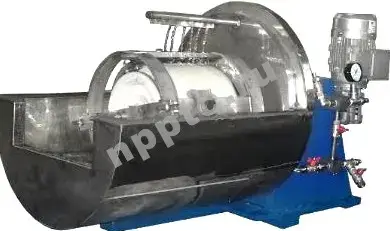
Laboratory cantilever ball mills with cooling serve as a powerful tool for scientific research and development in various industries. The uniqueness of such devices lies in their ability to carefully and efficiently grind materials, reaching ultra-fine particle sizes. Let's take a closer look at what tasks can be solved using these mills.
The main tasks of the laboratory ball mill with cooling
1. Production of ultrafine powders
One of the key applications of laboratory cantilever ball mills with cooling is to achieve extremely fine particle sizes, down to the micron level. This is important in cases where it is necessary to improve the properties of materials, such as their fluidity, surface area or absorbent properties.
Example of use: Production of catalysts, medicines, paints and cosmetics.
2. Mixing multicomponent mixtures
The mill allows you to thoroughly mix heterogeneous components, making it possible to create homogeneous composites. The mill's ability to intensively grind the material ensures excellent mixing and uniform particle distribution.
Usage example: Creation of metal alloys, composite materials, adhesives and pastes.
3. Giving certain properties to materials
Grinding using laboratory ball mills with cooling allows you to change the physical and chemical properties of materials. It can contribute to an increase in reactivity, a change in optical characteristics, the creation of amorphous structures, and much more.
Usage example: Changing the color, transparency, and electrical conductivity of materials.
4. Repeatability and reproducibility of results
Laboratory mills are ideal for testing and scaling grinding techniques. Thanks to precise control over the grinding parameters (rotation speed, mass of balls, cycle duration), scientists obtain repeatable results.
Usage example: Standardization of the grinding method in the research of new materials.
5. Careful handling of materials
Sometimes the crushed material may be sensitive to heat or oxygen. Laboratory ball mills with cooling operate in a vacuum or an inert gas atmosphere, preventing negative environmental effects.
Example of use: Treatment of medicines, explosive or unstable substances.
Why choose laboratory ball mills with cooling?
There are many good reasons why it is worth choosing laboratory ball mills with cooling.:
-
Opportunity