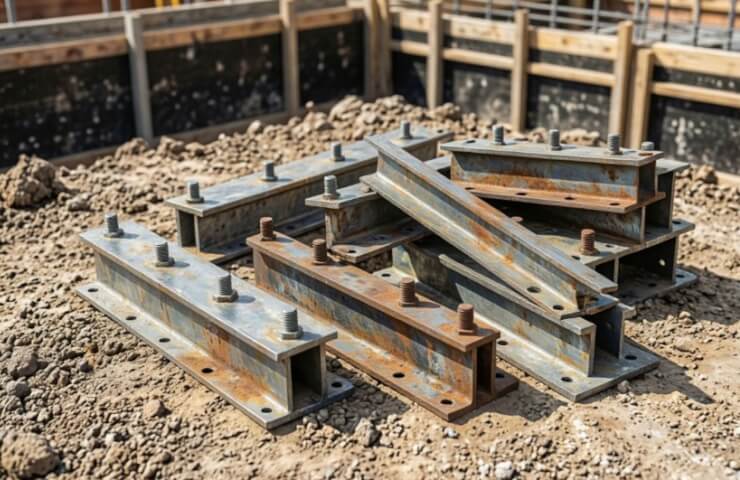
The embedded parts for foundations are the hidden element that determines whether the foundation will withstand the design load and whether a crack will appear on the concrete in a year.
Acceptance errors are often discovered after concreting, when fixing costs a lot of money.
Below are five practical rules that will help the construction control and the contractor not to miss critical defects.
The embedded parts of the foundations are anchor bolts, plates, sleeves and connecting elements that transfer the load from the aboveground structures to the concrete base.
Their acceptance at the facility is regulated by JV 70.13330.2012, GOST 10922 and project documentation.
Violation of at least one of the rules below leads to the fact that the part either will not withstand the design load, or will not provide the required durability.
Let's analyze each rule from a practical point of view.
Rule 1. Check the quality documents before starting the inspection
The first thing that any acceptance begins with is a passport or a manufacturer's certificate.
Reinforcement and embedded products must be delivered to the facility with a quality document indicating the steel grade, class and diameter of the anchor rods, type and welding results. Without this data, it is impossible to confirm that the part corresponds to the design of the KJ brand.
If the document is missing or the data is incomplete, the part cannot be used without laboratory tests.
The passport should reflect the results of mechanical tests of welded joints, and for embedded products, data on the grade of steel of the flat elements. Pay special attention to the batch: the batch of finished welded embedded products must consist of products of the same standard size, manufactured using a single technology by one welder.
Mixing batches from different welders is a common mistake made by suppliers, which complicates sampling and makes the results unrepresentative.
Rule 2. Perform a 100% visual inspection of every detail.
Visual inspection is not a formality, but a mandatory procedure.
When checking the condition of embedded products and welded joints before concreting, each product is visually checked for the absence of rust, frost, ice, contamination with concrete, scale and traces of oil. Special attention is paid to flaking rust and continuous surface corrosion.
The elements of reinforcement and embedded products should be free of peeling rust and scale, traces of oil and other contaminants. If the thickness of the corrosion products exceeds 300 microns, mechanical cleaning or treatment with alkali-based rust modifiers is required. Traces of oil are especially dangerous: they reduce the adhesion of concrete to metal and can cause corrosion under protective