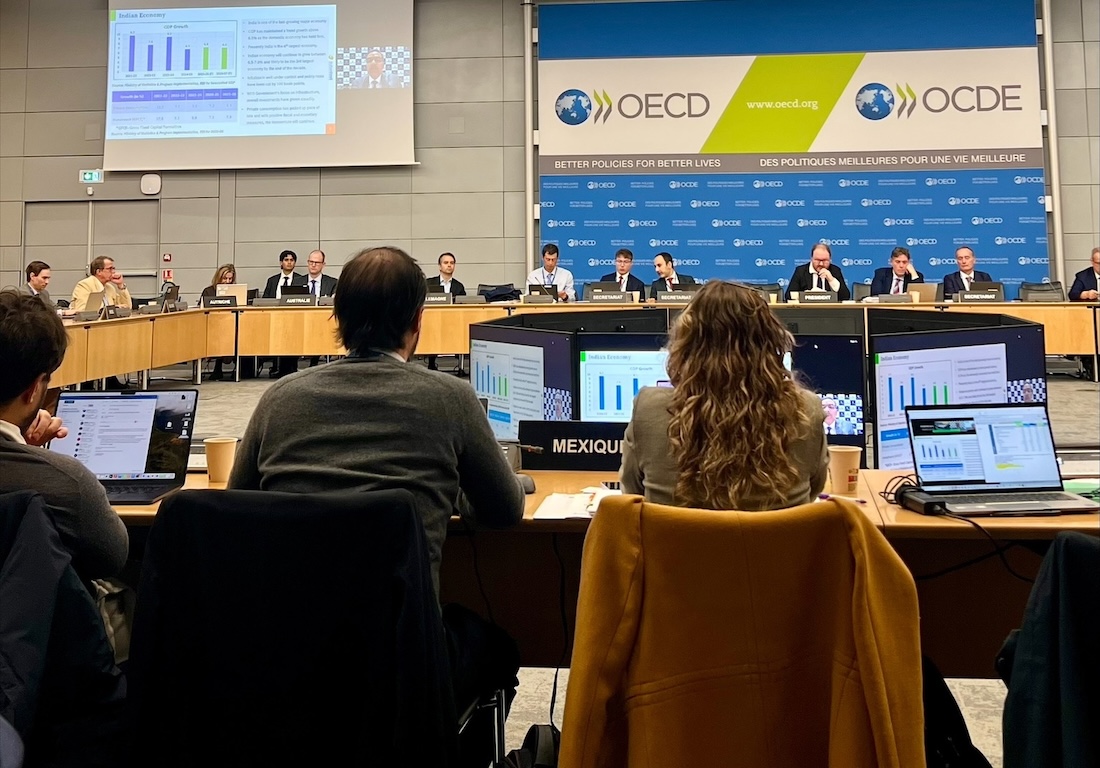
At the 98th session of the OECD Steel Committee, held in Paris on November 4-5, 2025, a total of 249 government and industry representatives from 43 delegations gathered to discuss the structural problems of the global steel market and possible policy responses. The meeting participants warned that the growing excess of production capacity and non-market practices are once again destabilizing international trade.
In a joint statement, Vice Chairmen of the Committee Cheryl Groenweg and Lieven Top noted that steel exports from China increased by 10% this year, reaching a record high. They stressed that this surge had a negative impact on manufacturers and workers in market economies, weakening the financial performance of companies. The statement also said that about a fifth of the planned low-carbon steel production projects worldwide have been suspended due to unfavorable market conditions and unfair competition.
According to the OECD, global excess steel production capacity could exceed 680 million tons in 2025. Global steel production capacity has been growing for seven consecutive years and is expected to reach 2.547 billion tons by the end of the year. Taking into account the fact that additional projects are planned to be launched by 2028, this figure may grow to 2.656 billion tons. Capacity expansion is mainly concentrated in Asia and the Middle East, especially in India and the ASEAN countries.
Delegates stressed that non-market measures, including energy subsidies, tax incentives, low-interest loans and preferential treatment for State-owned enterprises, distort competition and allow inefficient enterprises to continue operating. The OECD monitoring report identifies China, the Middle East and North Africa (MENA) region, and Southeast Asia as the regions where this practice is most common. The Committee stated that such a policy "distorts market signals and discourages private investment."
The report notes that trade imbalances related to excess production capacity persist despite existing protective measures. It is reported that Chinese manufacturers have increased exports of semi-finished products and low-value-added metal products in order to circumvent trade restrictions on finished products, as a result of which the markets of Asia, Africa and Latin America are becoming more vulnerable.
The participants agreed on the need for more coordinated global action within the framework of the Global Forum on Overcapacity in the Steel Industry (GFSEC). Referring to the resolutions adopted at the October GFSEC ministerial meeting,