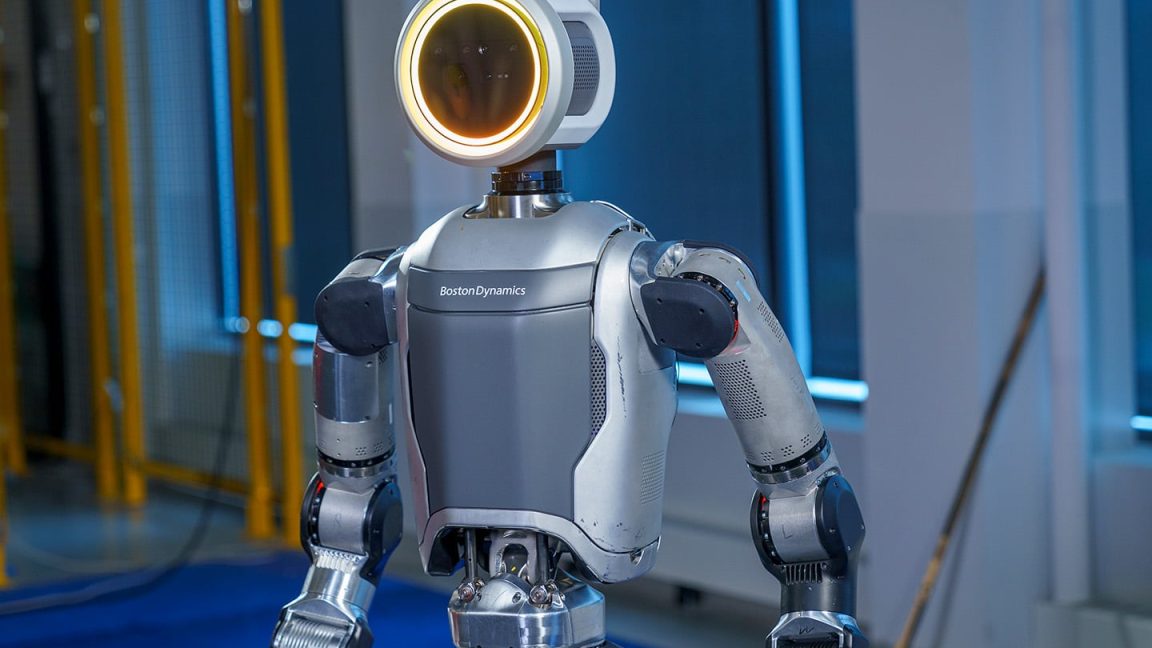
At CES 2026, Hyundai and Boston Dynamics presented a development that could dramatically change the future of logistics and distribution of steel products.
Powered by advanced artificial intelligence from Google DeepMind and implemented as part of Hyundai's broader industrial strategy, the Atlas fully electric humanoid robot has evolved from a research prototype into an enterprise—ready solution. For the steel sector, especially in distribution and service centers, this marks a shift that is no longer hypothetical. It is tangible, strategic, and inevitable.
For many years, the idea of humanoid robots operating in harsh and challenging environments such as steel warehouses or processing lines seemed like science fiction. Early-generation machines were noisy, fragile, and dependent on hydraulic systems that were poorly suited for real-world industrial applications. This era is over. Built on an electric platform, the new Atlas has the physical stability, agility, and intelligence needed to perform demanding, repetitive, and dangerous tasks— without having to redesign the workspace. It can climb stairs, avoid obstacles, withstand loads of up to 50 kilograms and operate autonomously for a long time thanks to self-replaceable battery systems. It is protected from dust and moisture by IP67 protection class, which means that it can withstand and operate in the harsh, unpredictable conditions of metalwork service centers.
What makes this innovation particularly relevant for the steel distribution sector is its adaptability. Traditional automation systems have long been challenged in warehouse environments where each order is different from the others and where processing steel — whether bars, rolls, sheets, or fittings — requires precision, strength, and flexibility. Atlas is successfully coping with this problem. It can assemble complex pallets with mixed loads, handle heavy tooling for a slitting line, transport samples for quality control, and even support press braking operations and welding preparation. These tasks traditionally required a person's judgment, endurance, and constant monitoring. Atlas now offers an intelligent robotic alternative that learns and adapts in real time and integrates directly into warehouse and production management systems.
What Hyundai is doing is particularly instructive. Combining the development of human-like robotics with the construction of its new ultra-low carbon steel plant in Louisiana