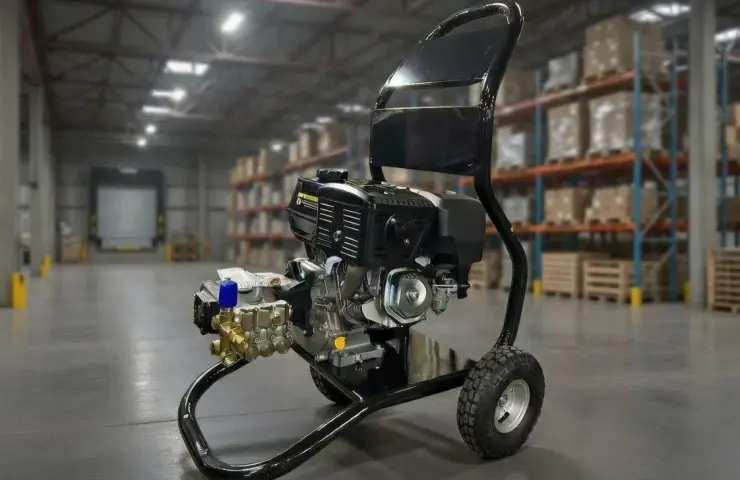
In a car service station, a high-pressure device does not solve the same problem as in a car wash. At the car wash, the car is washed outside, according to one scenario, dozens of times per shift. In the service, the jet is directed to the removed gearbox, to the engine compartment, to the bottom of the raised machine, to the oil—filled floor of the box - and each time a different pressure, flow rate and temperature are needed.
Hence the choice between stationary and mobile versions. This is not a matter of convenience: the water distribution, the electrics of the workshop and how much time the mechanic spends preparing for washing the part depend on it.
What is actually washed in a car service
The list of tasks is wider than it seems, and each one sets its own parameters.
Units and assemblies before repair. Boxes, gearboxes, axles, crankcases, frames. Pollution is a caked mixture of oil, dust and road dirt. You need high pressure and hot water or good chemicals, the consumption is secondary.
Under-hood space. Here it's the other way around: the pressure is limited, otherwise it tears off the connectors and drives the water under the insulation. They work carefully, in a reduced mode, with a foam nozzle.
Bottom and suspension on the lift. Washing from bottom to top, the operator stands under a stream of reflected water. You need a long hose, a light spear, and a machine that doesn't have to be dragged every time.
The floor and equipment of the box. Spilled oil, tire tracks, construction dust after bodywork. The flow rate works here, not the pressure: it is necessary to wash off the area.
Bodywork before painting and before acceptance. A delicate regime, clean water without suspension is required, otherwise risks will remain on the paintwork.
One device can be selected for all five scenarios, but it will be a compromise. Therefore, medium-sized services usually have a stationary post plus one mobile machine.
Stationary design: when washing is always in one place
A stationary circuit is an apparatus mounted on a frame or on a wall, with a permanent connection to water and electricity, and a high—pressure pipeline connected to the sampling points in the workshop.
The logic is simple: the heavy part of the installation is in the maintenance room, and the quick-release tubes are located in the boxes. The mechanic connects the hose to the nearest point and works.
What it gives.
The device is not rolled around the workshop, it does not receive shocks and does not collect metal shavings in the wheels. The pump life is higher, all other things being equal.
One device serves several posts, provided that one operator is working at the same time. Wiring two or three posts from one car is easier than two cars.
The noise remains in the technical room. For a workshop where people talk and listen to engines, this is noticeable.
380 V power supply becomes available: the device is in place, you need to pull the power cable to it once. For machines with a capacity of