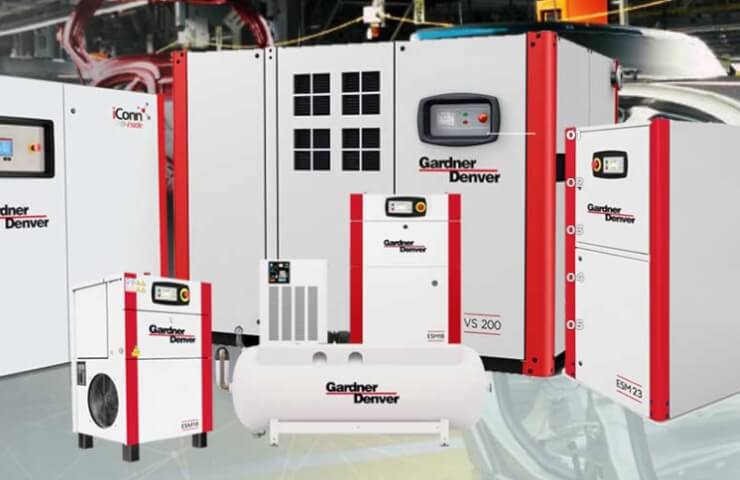
Compressed air has long been included in the top 5 strategic energy sources of the industry along with electricity, water, steam and natural gas. Today, it is the screw compressor that has become the heart of most pneumatic networks: from small workshops to mega-factories, from the electronics industry to the oil and gas complex. Its stepless pumping, high energy efficiency and durability make the technology an absolute favorite.
1. Evolution of compressed air: how the market came to the screw pattern
The first compressors were reciprocating: simple but noisy, with a high level of vibration and a limited valve life, the growth of production exposed their main problem — intermittent flow. The business needed continuous pressure without pulsations, and the engineers proposed a rotary-screw pair. Two coaxial screws with an asymmetric profile capture air, reduce its volume, displace it along the chamber — and do it smoothly, quietly, without back impacts.
2. Design and working principle: Why are screws so effective
The heart of the unit is a screw block. It consists of two rotating gears with an accurate axial clearance of hundredths of a millimeter. At the inlet, the air mixes with the oil mist (in oil-lubricated models), cools and simultaneously seals the gaps between the blades. As you move towards the discharge port, the space between the screws decreases, the pressure increases, and heat is removed through the oil cooler. Due to the absence of valve groups, the cycle is endowed with phenomenal mechanical and thermal stability, which ensures the life of the screw unit up to 100,000 operating hours.
3. The key advantages of a screw compressor over alternatives
- Continuous feed. The torque is evenly distributed, which eliminates pulsations and pressure surges.
- High efficiency at partial loads. The frequency converter adjusts the speed to the actual flow rate, reducing idling losses.
- Noise is below 70 dB(A). Allows the installation to be placed in close proximity to work areas without major noise isolation chambers.
- Compact layout. A screw unit occupies up to 30% less area per unit of productivity than a reciprocating or centrifugal unit.
- Long service intervals. Oil and filters are changed every 4-8 thousand hours, and scheduled repairs are required after 10-12 years of operation.
4. Life cycle Economics: where 80% of costs are hidden
Electricity costs account for the lion's share of the TCO (Total Cost of Ownership) of the compressor station. To illustrate, let's take a 55 kW installation with an operating pressure of 8 bar and an annual service life.