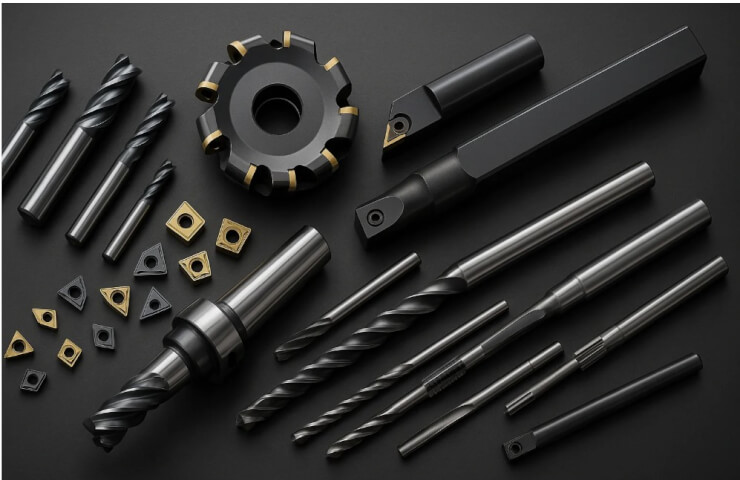
The Ukrainian machine shops are empty, the metalworking workshops are empty, the de kozhna khvilina is just a pittance. In addition, we need to choose the right tools and equipment, ensure stability of the process, secure the surface, and maintain the resource. I'd like to explain that you systematically steal the milling cutters, rizzis, sverdla, rozgortki, trimachi, and so on, without making predictions about the result of "expensive experiments."
1) We have both "tools" and "equipment"
With the help of a machine tool, you can use all the necessary geometry: cutters (monoliths), cutters (zminni plates with trimmers), drills, rods, zenkeri, mitches, broaches. Everything is equipped to ensure that the exact position of the tool and the blanks are not affected: trimmers, cartridges (ER, Weldon, thermal/thermal discs, gydropatrons), mandrels, adapters, collets, precision pliers, cartridges, prisms, plates, a system of high—speed snakes.
2) The materials of the instrument ta de voni dorechni
• Hard alloy (carbide): "robotic cognac" for steel, stainless steel, stainless steel and ring alloys. The skin (TiAlN, AlTiN, AlCrN thin) is less sticky and less sticky in dry/high-temperature conditions.
• Ceramics: highly visible to the eye, useful for chawun and jaromitzic alloys in black and white operations; sensitive to the impact.
• CBN (cubic boron nitride): hardened steel 55-65 HRC, finishnot exactly lock steel.
• PCD (polycrystalline diamond): aluminum alloys, composites; not for pheromagnetic materials.
• Shvidkoriz (HSS): sverdlinnya/narizannya rizi on the middle turns, if the shock is felt, I will tolerate it until mercy.
3) I'll tell you what the material of the details is, and I'll tell you later.
Promislova's practice is to rely on the ISO 513 classification for groups P (steel), M (stainless steel), K (chawuni), N (kolorovi), S (jaromici), H (charted). The purpose of giving a starting point for a hard alloy brand vibration, geometry, and chip breakers is to provide their own recommendations for the best system. For a clear guidance on the groups of materials, it is important to take into account the critical knowledge of the instrument specialist (div. distributed "Workpiece materials" to the Sandvik Coromant specialist). Sandvik Coromant
4) Regime change without dogmas: an algorithm for launching
If you don't "shoot" in the dark, run the skin operation according to the algorithm:
-
Vihidni tributes. The material behind the ISO group, the hardness, the mill of the workpiece surface; the layout of the system "workbench-tooling-instool-part".
-
Pochatkovi mode according to the virobnik catalog. For milling— there is a width of the rizanny vc, feed to the tooth fz, glibina ap and allowance ae; for precision— ap, f, vc.
-
The emphasis is on the heat supply. I can feel the regenerative vibration