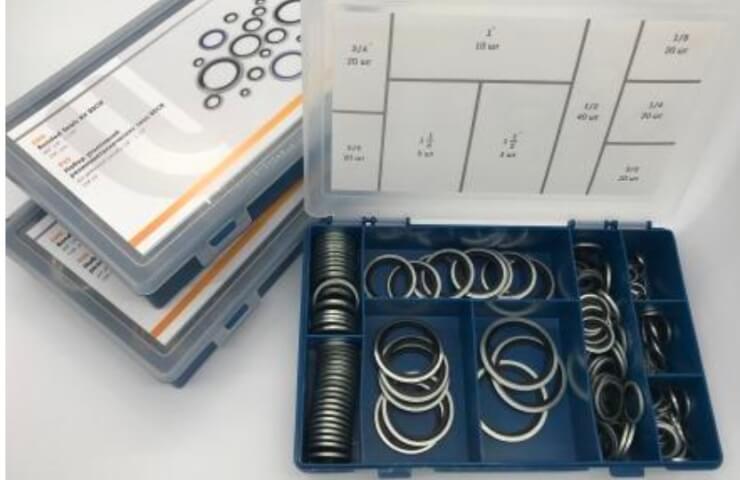
In modern industrial and engineering systems, sealing joints plays a key role in ensuring the durability and efficiency of equipment. One of the most reliable solutions is USIT rings (seals), rubber-metal rings that combine the advantages of elastic polymers and metal strength.
This article is devoted to the design features, operating principle, advantages and applications of USIT rings, as well as comparison with other types of seals.
Design and operating principle of USIT rings
USIT rings (from the English Universal Sealing and Insulating Technology) are combined sealing elements consisting of:
-
Metal frame (usually made of stainless steel or other alloys) – provides mechanical strength and resistance to deformation.
-
Rubber or polymer layer (NBR, FKM, EPDM, etc.) – responsible for sealing and vibration compensation.
The principle of operation:
-
Installation – the ring is mounted in the groove of the connection (flange, pipe, hydraulic cylinder).
-
Compression – when the joint is tightened, the rubber part deforms, filling the micro gaps.
-
Sealing – the metal base prevents the rubber from being squeezed out under high pressure.
Thanks to this design, USIT rings withstand:
-
High pressures (up to 1000 bar or more).
-
Temperature differences (-60°C to +200°C, depending on the material).
-
Aggressive media (oils, fuels, chemicals).
Advantages of USIT rubber metal rings
Compared to traditional seals (rubber rings, gaskets, cuffs), USIT rings have a number of advantages:
Additional advantages:
✅ Versatility – suitable for hydraulics, pneumatics, and the oil and gas industry.
Vibration resistance – the metal base dampens vibrations.
✅ Re–installation - some models allow multiple use.
Areas of application of USIT rings
Due to their reliability, USIT rings are used in:
Industrial hydraulics and pneumatics
-
Sealing of hydraulic cylinder rods.
-
Sealing of high-pressure connections.
Oil and gas industry
-
Pipe fittings (closures, valves).
-
Drilling equipment.