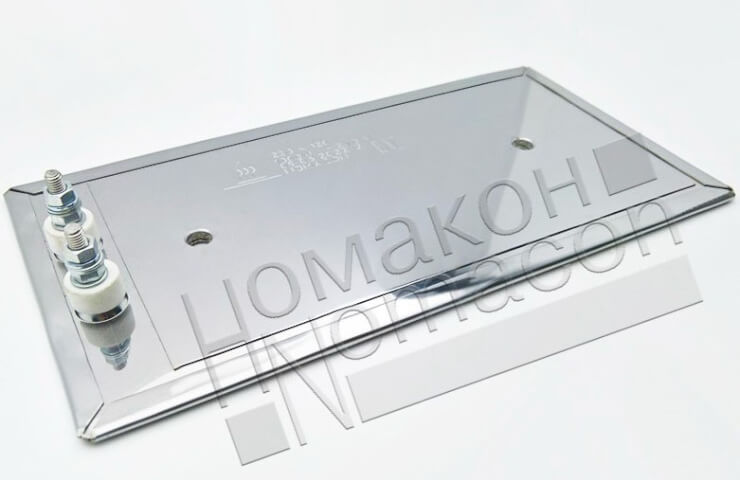
Flat micanite heaters in industry: how does thermal engineering calculation affect the resource, accuracy and energy efficiency of equipment
The heating system has long ceased to be a secondary component in industrial equipment. For many technological processes, it determines the stability of output, the quality of finished products, and the predictability of the entire line. This is especially noticeable in cases where contact heating is required with a limited installation area and high temperature uniformity, for example, in packaging machines, molds, extrusion units, welding plates and thermal knives. Flat micanite heaters are widely used in such tasks.
At first glance, it may seem that the efficiency of a heater is determined by its power and ability to quickly reach a set temperature. However, this is not enough for real industrial operation. The engineering value of a heating element lies elsewhere: in its ability to stably generate the necessary heat flow, compensate for losses, avoid local overheating, and maintain performance over a long service life.
That is why the correct choice and design of a flat micanite heater requires not only knowledge of electrical parameters, but also an understanding of the physics of heat transfer, the features of mechanical installation, the properties of contacting materials and the logic of the automatic control system.
The heater as an element of the thermal system, and not as an autonomous temperature source
One of the key mistakes when selecting an industrial heater is an attempt to evaluate it in isolation from the equipment. In a real car, the heating element always operates inside a complex thermal system, where temperature is only an external manifestation of the energy balance.
The heat generated by the heater is simultaneously consumed in several directions. Part of the energy is used to heat the metal mass of the assembly, part is transferred to the technological material, part is lost to the environment through open surfaces, fasteners, supporting parts and adjacent structural elements. Additionally, the thermal regime is affected by the cyclical nature of the process, acceleration and stop modes, changes in performance, the presence of external cooling and the operation of automatic control circuits.
From an engineering point of view, the task of a heater is not just to create a high temperature, but to ensure a steady and controlled heat flow in a specific area of the equipment. If it's not