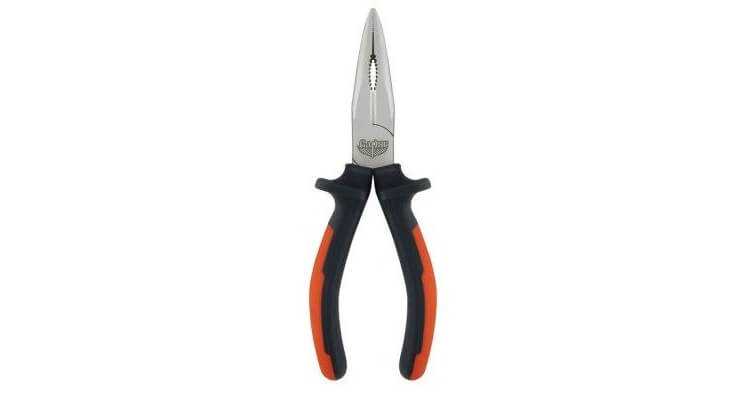
When performing plumbing, installation and repair work, it is not always possible to get to the part with ordinary pliers or pliers. In such situations, long pliers come to the rescue — a type of hinged-lip tool with elongated and narrow working jaws. Their design allows you to grab small parts and wires in places with limited access.
What are long pliers for?
The main advantage of long pliers is the shape of the working part. The narrow, elongated jaws allow for penetration into small process openings, recesses, and other hard-to-reach areas. At the same time, the tool provides a controlled capture of small elements.
Long pliers are used in electrical installation, repair of household appliances, automotive work, assembly of mechanisms and other fields. They can be used to hold wires, small fasteners, metal parts, and perform various wire operations. Some models are additionally equipped with cutting edges.
The main tasks of the tool
- capturing and holding small parts;
- working with wires and cables in a confined space;
- bending and positioning of the wire;
- extracting small elements from the recesses;
- assembly and assembly operations;
- work with parts located deep inside the body or mechanism.
At the same time, long pliers should not be considered as a substitute for powerful pliers. Due to the elongated working part, the tool is primarily focused on accuracy and accessibility, rather than creating maximum effort. Therefore, for forceful gripping of large parts, it is better to use a tool designed specifically for such loads.
How do long pliers differ from thin pliers and round pliers?
All these tools belong to the hinge-lip group, but they have a different shape of the working part. Long-nosed and thin-nosed sponges are usually elongated, narrow and have a flat or semicircular section. This makes them convenient for gripping and manipulating in narrow spaces.
Round pliers are distinguished by rounded, often conical jaws. They are used primarily to form loops, rings, and other smooth bends of wire. Therefore, the choice of a particular tool depends on the nature of the work, and not only on its external similarity to other pliers.
Long pliers in the home workshop
This tool is useful not only for professionals. In a home workshop, long pliers can be useful when repairing electrical appliances, assembling furniture, working with fasteners, wire, and small metal elements. Thanks to the narrow sponges, they help to perform operations.