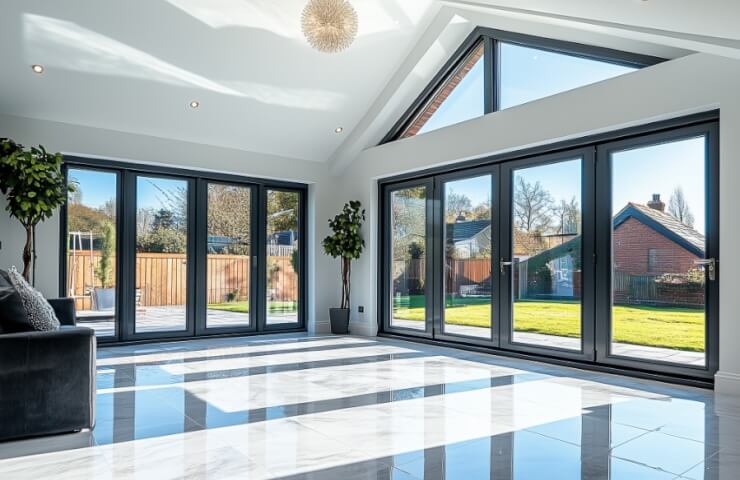
Bifold doors have moved from luxury add-ons to mainstream renovation choices. They fold neatly to one side on a track, opening an entire wall to the garden or terrace while keeping high thermal and security performance when closed.
This guide explains how bifold doors work, what to look for in the specification, realistic price ranges, and how they compare with sliding or French doors.
1. How a Bifold Door Works
- Panels (leaves): usually 2–7, hinged together.
- Track & rollers: panels glide on a bottom track (most common) and are guided by a head track.
- Stacking: all panels fold to one or both sides; most sets include a traffic door you can use like a regular door.
- Threshold: either rebated (better weather-seal) or low threshold (easier access; needs careful drainage).
2. Material Choices and What They Mean
| Material | Typical Sightline | U-Value Potential* | Lifespan & Care | Notes |
|---|---|---|---|---|
| Aluminium | Slim (110–140 mm) | ~1.2–1.6 W/m²K (double), ~0.9–1.2 (triple) | 30+ years; minimal maintenance | Best for large spans; sleek frames; marine-grade coating advised near coast. |
| uPVC | Medium (150–180 mm) | ~1.2–1.5 W/m²K (double), ~0.9–1.2 (triple) | 20–30 years; easy care | Good value; chunkier look; limited width range. |
| Timber | Varied | ~1.1–1.4 W/m²K | 25–40 years; needs upkeep | Beautiful natural finish; engineered timber recommended. |
*Aim for ≤1.4 W/m²K to meet or exceed most UK/EU energy regulations.
3. Size, Panels and Configuration
- Single panel width: ideal 700–1,000 mm per panel.
- Max span: 3.0–6.2 m wide, 2.0–2.4 m high typical.
- Panel counts:
- 2–3 panels → openings 2.0–2.8 m
- 4–5 panels → openings 3.1–3.7 m
- 6–7 panels → openings 4.0–6.2 m
- Traffic door: layout with one everyday-use door (e.g., 3-panel 2+1, 4-panel 3+1).
4. Performance You Can Verify
When comparing quotes, request actual test reports for:
- Thermal transmittance (whole-door U-value)
- Air permeability: Class 3–4 (EN 12207)
- Water tightness: Class 7A–9A (EN 12208)
- Wind resistance: Class C3+ (EN 12210)
- Security: PAS 24 (UK) / RC2 (EN 1627)
- Hardware: stainless steel or anodised aluminium rollers
5. Glazing Choices That Matter
- Double vs triple glazing — triple gives better insulation but adds weight.
- Low-E glass + warm-edge spacers — standard for efficiency.
- Laminated panes — add security and UV protection.
- Solar control tints — prevent overheating on south-facing façades.
- Acoustic glazing — for busy roads or flight paths.
6. Realistic Cost Ranges (Supply & Install, incl. VAT)
| Material | Size Example | Typical Cost Range |
|---|---|---|
| Aluminium bifold (4 panels, ~3.2–3.6 m × 2.1 m) | — | £6,000–£11,500 |
| uPVC bifold (4 panels, ~3.2–3.6 m × 2.1 m) | — | £4,500–£9,000 |
Factors that increase cost: extra panels, triple/laminated glass, low-threshold systems, marine-grade or dual-colour finish, and structural work.
7. Bifold vs Sliding vs French Doors
| Feature | Bifold | Sliding | French |
|---|---|---|---|
| Opening width | Up to ~95% | 50–66% | ~100% of small span |
| Best for | Wide openings, indoor–outdoor feel | Panoramic glass | Compact openings |
| Sightlines | Wider per panel | Slimmest | Traditional |
| Everyday use | Traffic door | One sliding panel | One active leaf |
| Cost | Mid–high | Mid–high | Low (small sizes) |
Summary: Sliding doors offer the best uninterrupted view, while bifolds create a full-opening “wall-off” experience ideal for summer entertaining.
8. Installation and Survey Essentials
- Ensure solid lintel/steel support – bifolds need rigidity.
- Plan threshold & drainage early – low thresholds require proper design.
- Powder-coated aluminium sub-sills protect brickwork.
- Allow for expansion gaps and correct packing.
- Clean bottom track regularly; inspect rollers annually.
9. Coastal & High-Exposure Sites
- Use marine-grade coatings (e.g., Qualimarine).
- Prefer stainless steel 316 hardware.
- Consider inward stacking to protect finishes.
- Ensure Class 9A water tightness & robust drainage.
10. Common Pitfalls (and How to Avoid Them)
- No traffic door – inconvenient most of the year.
- Oversized uPVC panels – may flex.
- Low threshold without drainage – risk of leaks.
- Glass-only U-value quoted – insist on whole-door value.
- Missing security rating – specify PAS 24/RC2 with laminated glass.
11. What a Good Quote Should Include
- Clear configuration drawing (stacking side, traffic door position)
- Panel sizes and visible sightlines
- Whole-door U-value, air/water/wind classes
- Glass specification and thickness
- Threshold type, cill/sub-sill, finish (inside/outside), hardware
- Accreditations: FENSA/Certass, installation warranty, manufacturer guarantee
- Lead time and making-good terms
12. Where to Start
Use online calculators or comparison tools like Bestpricevalue.com to check realistic bifold pricing by postcode and specification — free and no sign-up required.
Bottom Line
A well-specified bifold door enhances comfort, security, and efficiency — transforming your kitchen-diner into a flexible indoor–outdoor space.
- Prioritise material rigidity, tested performance, and proper drainage.
- Include a traffic door for everyday use.
With consistent specifications and a few vetted quotes, you’ll find a system that looks stunning and performs perfectly for your home and climate.