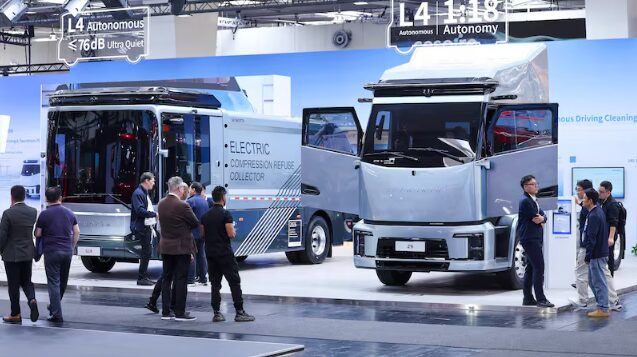
European truck manufacturers are increasing pressure on Brussels to take stronger action against unfair subsidies and limited market access. However, there is still no consensus among industry players on the issue of duties, Automotive News writes.
The reason for the new discussion was the IAA Transportation exhibition in Hanover, where Chinese companies turned out to be the largest foreign delegation: 363 participants out of about 1,600 exhibitors. This once again showed how fast China is expanding its presence in the European commercial vehicle market.
The head of MAN, Alexander Weissenhofer, called on the EU to introduce measures comparable to Chinese requirements for localization and joint ventures. He mentioned the trade policies of the United States and Turkey, which use tougher barriers to protect the domestic market, as possible benchmarks.
Martin Lundstedt, CEO of the Volvo Group, supported the idea of mutual market access and countermeasures against subsidies that distort competition, but did not advocate uniform import tariffs.
The head of Daimler Truck, Karin Radstrom, took a different position. According to her, European manufacturers should benefit from technology, reliability and the total cost of ownership of equipment, not through duties. At the same time, she supported the requirements for a European share in public procurement, especially in the bus segment, if such rules take into account not only production, but also research, development and innovation, and do not create unnecessary bureaucracy.
Against the background of these disputes, BYD plans to bring the ETT 44 heavy truck to the European market in 2027 and further launch production of commercial vehicles on site. The company has not yet disclosed either the location of the future plant or the start date of production.
BYD Executive Vice President Stella Lee said that localization will reduce the impact of possible import duties. In fact, this makes a new wave of trade protection less effective if manufacturers from China start assembling equipment in Europe.
Thus, there is increasing support for targeted protective measures in the industry, but market participants themselves recognize that barriers alone are not enough. To maintain their position, European companies will have to accelerate innovation and increase competitiveness amid growing pressure from China.


