EUROMETAL participated in the UAHE 2025 General Assembly (La Union de Almacenistas de Hierros de España), which took place yesterday in Madrid and brought together key representatives of the Spanish steel distribution and warehousing sector.
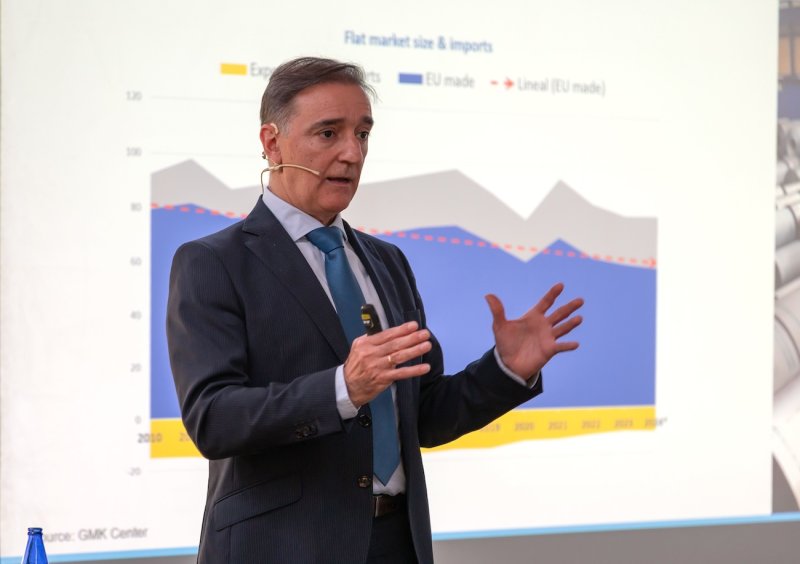
EUROMETAL was represented by Vice President Fernando Espada, who is also CEO of Tata Steel Layde in Durango. He delivered a keynote address on the current challenges facing the European long products and flat products market, providing a comprehensive overview of macroeconomic trends, industrial activity, and market expectations across the continent.
Espada noted a tendency to diverge between the segments of long products and flat products. The construction sector, which primarily determines the demand for long products, has shown weakness in recent quarters, mainly due to high borrowing costs. However, recent signs of stabilization and an expected reduction in interest rates have improved sentiment. The EU27 Public Infrastructure Index indicates a positive trend in the medium term, signaling a potential recovery in public works and civil engineering.
On the other hand, the market for flat rolled products remains weak, and the level of demand is estimated as "almost unchanged". Despite this, manufacturers and service centers maintain production facilities, cautiously optimistic about the potential rise of the industry.
Espada stressed that in addition to the dynamics associated with a particular product, the main task of the European industry is to maintain activity and maintain steel consumption in the face of structural transformations, including digitalization, decarbonization and pressure from global trade.
"Maintaining manufacturing activity in Europe is important not only for steel consumption, but also for the sustainability of our entire value chain," he said.
Espada also spoke about the implementation of the Carbon Emissions Regulation Mechanism (CBAM) and its expected impact on the steel supply chain. Reaffirming support for the EU's decarbonization goals, he stressed the need for clear leadership, transparency and coordinated implementation in member states to ensure fair competition and operational predictability for importers, traders and service centers.
He noted that many distributors are still facing the difficulties of CBAM. He called on policy makers to work closely with the steel distribution sector, in particular, to avoid creating a disproportionate burden on small and medium-sized enterprises.