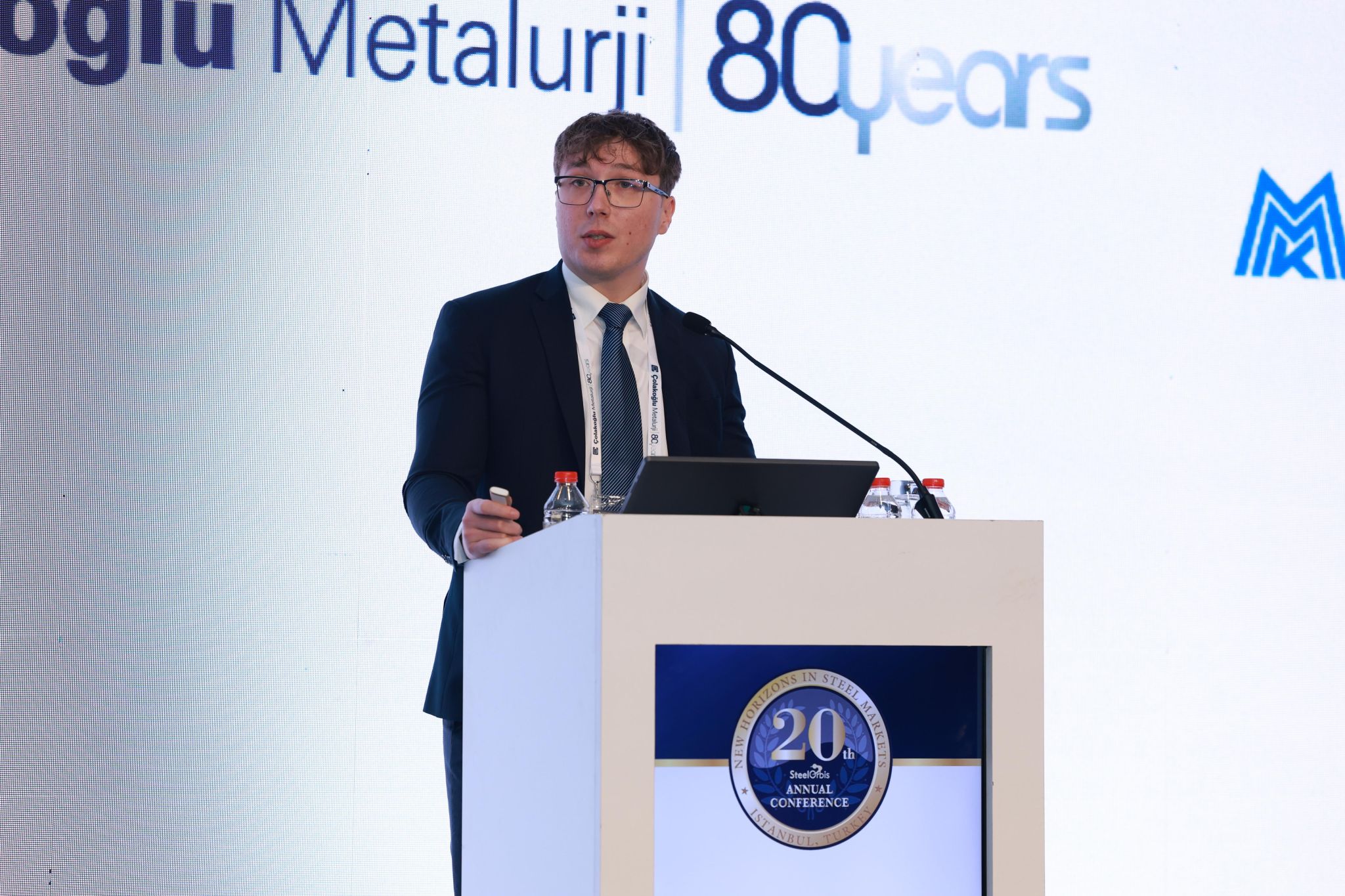
At the 20th SteelOrbis conference "New Horizons in Steel Markets", which took place on Tuesday, December 9, at the Marriott Hotel Asia in Istanbul, Luciano Giua, economist and policy analyst at the Organization for Economic Cooperation and Development (OECD), presented an overview of the situation in the European steel market. the market in 2025.
Global excess steel production capacity
The first thing Mr. Jua touched upon in his speech was the global excess steel production capacity. In Europe, production capacity is expanding at a rapid pace, but demand is not following them. This will lead to production capacity exceeding 700 million tons by 2027, especially in countries that are already experiencing excess production capacity.
Another factor driving excess capacity is subsidies such as grants, financing at below-market prices, tax breaks, and subsidized energy, which keep unprofitable firms in the market. "The level of subsidies in China is about ten times higher than in the OECD countries," he said.
To address this critical issue, the Global Forum on Overcapacity in the Steel Industry (GFSEC), a multilateral platform established by the G20 in 2016 and bringing together 28 major steel producing countries, has identified three key areas where coordinated action is needed.:
- Monitoring: Deepen work on non-market policies and practices to understand the economy beyond the GFSEC.
- Improving the effectiveness of trading actions: sharing experiences on issues such as melting and pouring, identifying workarounds, and sharing data and methodologies to enhance trading actions.
- Collective action: develop a comprehensive framework by June 2026.
Mister. Jua stressed the importance of cooperation, stating: "Our goal now is to move from diagnosing the problem to finding solutions that will support the global steel industry. No single economy can handle excess capacity alone."
Demand in Europe is expected to remain weak in 2025
The OECD representative then said that European manufacturers do not expect demand to recover in 2025. While manufacturing activity continues to grow in Asia, demand in most key sectors in Europe (mechanical engineering, automotive, etc.) remains very weak, and the situation in the United States is quite unstable.
Due to this decrease, prices are likely to be low in the coming months. In early 2025, sentiment began to weaken, and worsened in the second half of the year.
High energy consumption contributes to lower production