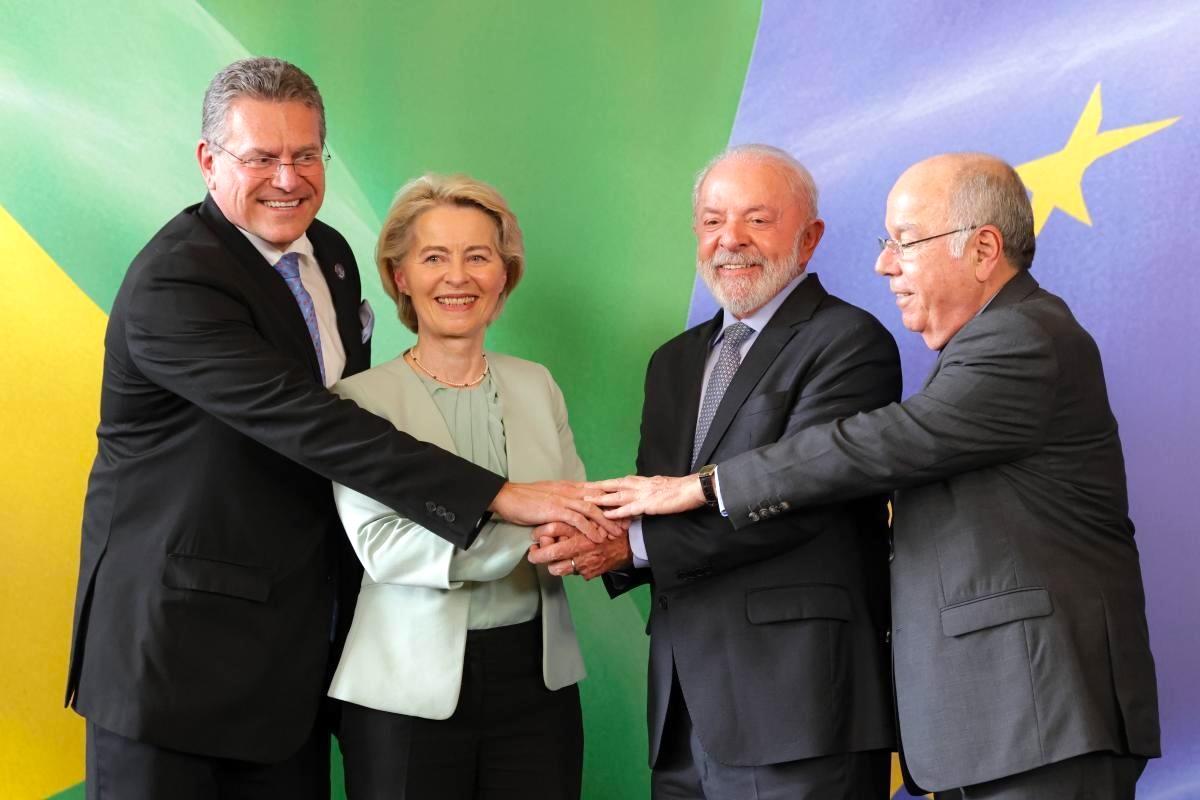
On January 16, European Commission President Ursula von der Leyen announced that the EU and Mercosur had reached a "political agreement" on raw materials issues, which provides a framework for cooperation on joint investments in lithium, nickel and rare earth projects.
Such an agreement would ensure "strategic independence in a world where minerals tend to become instruments of coercion," von der Leyen told reporters in Rio de Janeiro after meeting with Brazilian President Luiz Inacio Lula da Silva to discuss details of the broader EU-Mercosur trade agreement, which was formally agreed on January 9. by most of the participating countries. The EU hopes to gain access to the agricultural and metallurgical sectors of the four-country bloc. Mercosur countries are seeking to circumvent US trade restrictions and counter China's growing influence.
The official signing of the agreement will take place on January 17 in Asuncion, Paraguay, one of the four participating countries of the Latin American common market of the Southern Cone countries, along with Argentina and Uruguay.
According to the agreement, EU import duties on Mercosur mineral products, including essential minerals, copper, aluminum, ferroalloys and steel products, must be abolished within 10 years. Brazilian iron ore is already supplied to the EU at a zero tariff.
Both von der Leyen and Lula stressed the importance of creating new strategic supply chains in the field of energy and digital transition, attracting new investments to support sustainable development within the framework of the EU—Mercosur agreement.
Lula noted that this will encourage new EU investments in Mercosur.
"But we[in Mercosur]will not be limited to being eternal exporters of raw materials; we want to produce and sell industrial goods with higher added value," he said.
The Brazilian Mining Institute Ibram noted in a statement on January 15 that the revision of the EU—Mercosur agreement for 2023-24 will allow Brazil to begin implementing the policy proposed by its government at the end of 2025 and currently under consideration by the country's Congress, which stipulates that at least 80% of mining will be carried out. According to the law, the production of rare earths in the country should be processed into value-added products within the country, rather than exported as raw materials.
According to Ibram, the idea will now be to attract EU investments in the processing of rare earths in Brazil. Brazil ranks second in the world in terms of reserves of rare earths after China, but currently it has