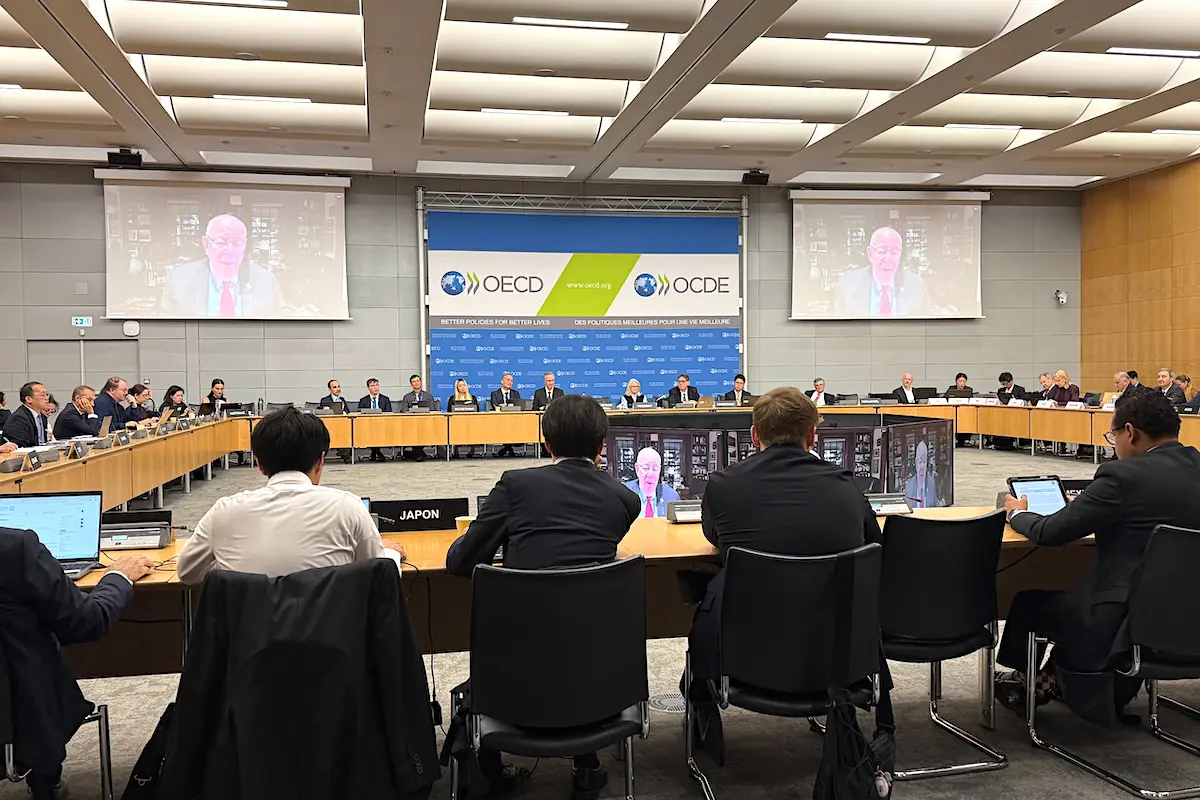
Global excess steelmaking capacity could exceed 700 million tonnes by the end of 2026, according to a forecast in a statement by the chair of the OECD Steel Committee, whose 100th meeting was held on November 18–19 at the organization’s headquarters in Paris. EUROMETAL Director General Ricardo Silva took part in the discussions; on November 17, he also joined a stakeholder event of the Global Forum on Steel Excess Capacity (GFSEC).
The anniversary session was attended by 279 representatives from 46 government and industry delegations. Participants discussed the growth in excess capacity, market-distorting practices and the need for international cooperation. The OECD is an organization that brings countries together to discuss economic policy; its Steel Committee examines developments in the global steel industry.
Global steel demand fell by 1.6% year on year in the first half of 2026. Meanwhile, steelmaking capacity grew at a rate equivalent to 88 million tonnes a year, reaching a record 2,533 million tonnes. More than 90% of net additions came from non-OECD countries.
Delegates discussed ways to strengthen monitoring, enforcement and information sharing to help governments tackle imbalances and their causes. The committee also noted that steel from regions with excess capacity is increasingly reaching markets in the form of steel-containing goods, including cars and equipment. This is putting greater pressure on local supply chains; participants cited the circumvention of trade restrictions and the diversion of trade flows among the ongoing challenges.
EUROMETAL considers coordinated policy across the entire steel value chain necessary. In the organization’s view, measures affecting steel supply should be assessed alongside the competitive pressure on European processors and manufacturers that underpin demand for the metal. Protecting the steelmaking industry, EUROMETAL says, must go hand in hand with preserving competitiveness, investment and jobs in distribution, processing and finished goods manufacturing.
The committee welcomed GFSEC’s adoption of the Milwaukee Framework, calling it an important step toward joint action against excess capacity and its root causes. Participants also examined subsidies and other non-market practices, investment in steelmaking facilities abroad, restrictions on raw materials and supply chain vulnerabilities. They concluded that the problem cannot be solved by focusing only on imports from a single country.
The meeting discussed the committee’s draft work programme and budget for 2027–2030. Proposals included expanding the analysis of subsidies across the entire industry value chain, identifying suspicious trade patterns early and assessing the effectiveness of trade measures.
The statement by the chair of the 100th meeting of the OECD Steel Committee has been published.