The technology, which the company called "revolutionary," allows the recycling of dirty scrap with impurities into high-quality metal with a record low carbon footprint.
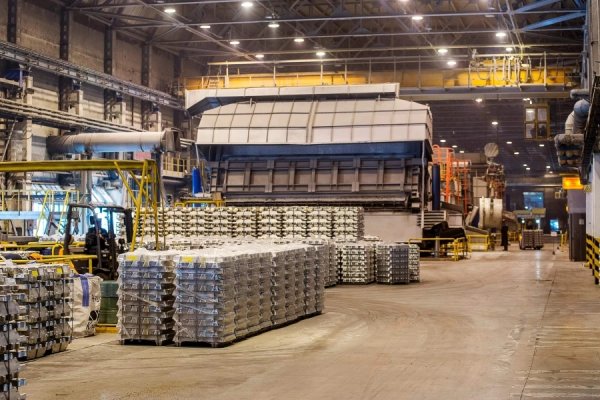
Finished products at the Irkutsk Aluminum Plant. Illustrative photo: RUSAL.
As a result of processing, a high-purity metal is obtained, equivalent to primary aluminum grade P1020 (A7 according to the Russian classification, purity above 99.7%).
An important problem for the aluminum industry is the recycling of contaminated scrap, said Viktor Mann, Technical Director of RUSAL.
"Traditional processing in melting furnaces of scrap with a high content of impurities, for example, iron and copper, even after applying existing purification methods, leads to downcycling – the production of low-grade alloys with a limited scope of application. RUSAL's innovative technology solves this problem by providing a complete closed metal cycle without loss of quality and the ability to use recycled metal in high-tech industries such as automotive, aerospace, and food packaging."The unique design of the electrolyzer created by RUSAL ensures electrochemical cleaning of scrap at low cost and high energy efficiency. The technology turns low-quality scrap (quoted below the LME price) into P1020 grade aluminum (quoted at the LME price plus a regional premium).
The technology has been successfully demonstrated on prototypes of electrolyzers with a current of 500 A and 3 kA. The tests confirmed: high purity of the product and stable production of aluminum with a purity of over 99.7%; operational stability - the prototypes achieved stable operating cycles lasting 40-45 days; high energy efficiency - approximately 9 MWh of energy is consumed to produce one ton of aluminum from scrap. For comparison, the most efficient traditional electrolyzers use 12-14 MWh of energy to melt one ton of metal from alumina.
The technology is designed, among other things, for recycling old household scrap with a zero carbon footprint. In combination with "green" energy sources (RUSAL uses hydroelectric power), the technology makes it possible to produce P1020 grade metal with a carbon footprint of less than 1 ton of greenhouse gases in full coverage. The average carbon footprint of the global aluminum industry in terms of full coverage is an order of magnitude higher – 14.8 tons of CO2 per ton of metal.