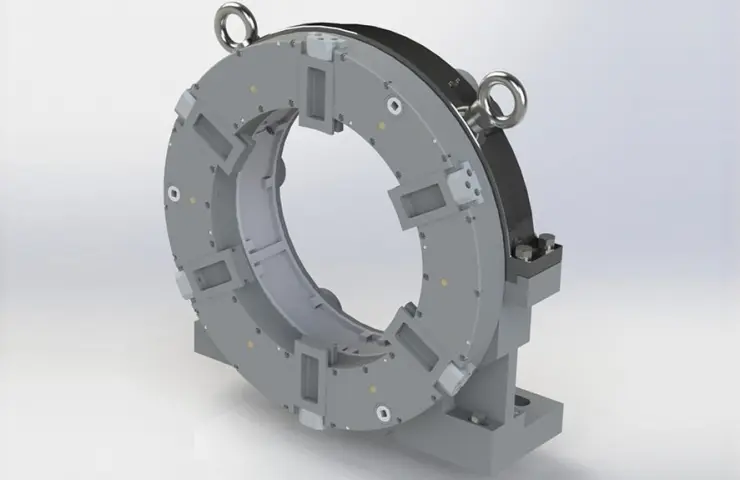
Injection molding is widely used in the serial and mass production of parts made of plastics and metal alloys. The technology makes it possible to produce products of complex geometry with high dimensional repeatability, however, the quality of the final product is largely determined by the tooling used. Properly designed casting molds must take into account the properties of the material, the design of the future product, the equipment parameters and the planned production volume.
How the injection mold works
The principle of the technology is to fill the forming cavity with molten material. After filling, the material cools and hardens, acquiring the desired geometry. Then the product is removed and the production cycle repeats.
Despite the apparent simplicity of the process, the design of the mold itself is quite complex. It includes forming elements, a gate system, ejection mechanisms and a cooling system. For individual production tasks, movable elements, ventilation ducts and other technical solutions are additionally provided.
Why Design is crucial
Mistakes made during the development of tooling can subsequently be repeated in every manufactured part. Incorrect location of the melt supply points can lead to filling defects, and insufficiently efficient cooling can increase the duration of the production cycle.
Engineers need to take into account the dimensions of the product, the wall thickness, the shrinkage of the material, the location of the connector line and the method of extracting the finished part. At the same time, the design must meet the characteristics of a specific injection molding machine.
Equipment for working with metals
When casting metal alloys, the mold is subjected to significant temperature and mechanical stress. The design takes into account the melt temperature, injection pressure, crystallization rate and the amount of shrinkage during cooling.
Special requirements apply to the material of the working elements. Tool steels are used for manufacturing, capable of withstanding multiple heating and cooling cycles. The resource of the tooling directly depends on their characteristics.
Features of Aluminum casting
Aluminum alloys are in demand in mechanical engineering and other industries due to the combination of relatively low weight and good mechanical characteristics. However, when designing the mold, it is necessary to take into account the high thermal conductivity of aluminum, the formation of an oxide film and shrinkage processes.
Ventilation systems are designed to achieve a stable result.