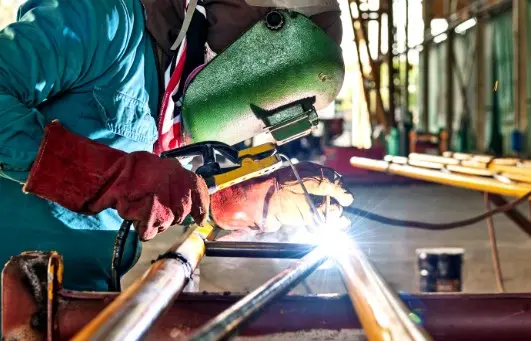
Among the many existing welding technologies, three arc processes are most common: manual arc welding with a coated electrode for MMA welding, semi-automatic welding in a protective gas environment (MIG/MAG) and argon arc welding with a non-melting electrode (TIG). Let's consider their working principle, features and applied welding materials (electrodes, wire, fluxes).
Manual Arc Welding (MMA)
MMA – welding with a coated piece electrode. When the electrode touches the product, an electric arc occurs, melting the metal of the rod and base. The electrode melts, forming a weld, and the coating burns with the release of a protective gas and the formation of a slag crust, which protects the molten metal from the air.
The MMA method is simple and versatile: it only requires a welding machine (inverter) and suitable electrodes. Its advantages include low cost of equipment, mobility and the ability to work in any spatial position, including outdoors. The disadvantages of the method are low productivity and the need to clean the seam of slag after cooling.
Semi-automatic welding (MIG/MAG)
MIG/MAG – arc welding with melting wire in a protective gas environment. Instead of a piece electrode, a wire from a coil is used, which is automatically fed into the arc zone and melts, forming a seam. At the same time, a protective gas is supplied through the burner nozzle, shielding the welding bath from the air. There are two variants of the process:
-
MIG welding in an inert gas (argon, helium, etc.), usually used for aluminum, copper and other non–ferrous metals.
-
MAG – welding in an active gas (carbon dioxide co₂ or its mixtures), is mainly used for steels (low carbon, stainless, etc.).
Semi–automatic welding ensures high speed of operation; when using solid wire with protective gas, the weld is clean – practically free of slag and splashes - and does not require laborious stripping. Among the disadvantages of MIG/MAG is limited mobility (requires a gas cylinder, hoses, and other equipment). The process is sensitive to wind: outdoors, the gas flow can be blown away, so either protective screens or self-protective powder wire without gas are used for outdoor work. You can buy welding wire at an acceptable price directly from the manufacturer or its offline outlets (most likely through distributors) and on marketplaces - this also applies to other welding materials.