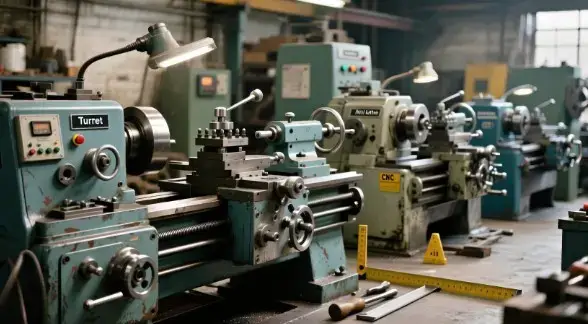
Lathes are equipment for processing bodies of rotation, which has gone a long way in evolution from the simplest manual devices to high—tech computer systems. The article discusses the main types of lathes for turning operations, their features and applications.
Classification of lathes
By the level of automation
- Manual and mechanical machines
- Semi-automatic vehicles
- Vending machines
- CNC machines (numerically controlled)
- Machines with adaptive control systems
By specialization
- Universal (general purpose)
- Specialized
- Special
By layout
- Desktop
- Outdoor
- With a horizontal axis of rotation
- With a vertical axis of rotation
Types of lathes
1. Turning and screw-cutting machines
Turning and screw-cutting machines are universal equipment for processing bodies of rotation, which is the basis of mechanical processing in mechanical engineering. These machines allow you to perform a wide range of operations and are especially appreciated for the ability to thread various profiles. Turning and screw-cutting machines are designed for processing workpieces such as bodies of rotation (shafts, discs, bushings) and threading. The main movement is the rotation of the workpiece, and the feed movement is the translational movement of the cutting tool.
Basic operations performed on turning and screw-cutting machines:
- Turning of external cylindrical and conical surfaces
- Drilling of internal cylindrical and conical surfaces
- Trimming of ends and ledges
- Treatment of shaped surfaces
- Cutting of external and internal threads (metric, inch, modular)
- Drilling, countersinking and hole deployment
- Cutting off parts of the workpiece
Advantages and disadvantages of turning and screw-cutting machines
Advantages
- Versatility — the ability to perform a wide range of operations
- Relative simplicity of design and maintenance
- The possibility of threading various profiles
- Wide availability of tooling and tools
- Low requirements for operator qualifications for basic operations
Disadvantages
- Low productivity compared to automatic machines
- The dependence of processing quality on the qualification of the turner
- Limited processing capabilities for complex parts
- The need for frequent readjustments when changing operations
Areas of application of turning and screw-cutting machines
- Single and small-scale production
- Repair shops and services
- Educational institutions
- Experimental and development projects