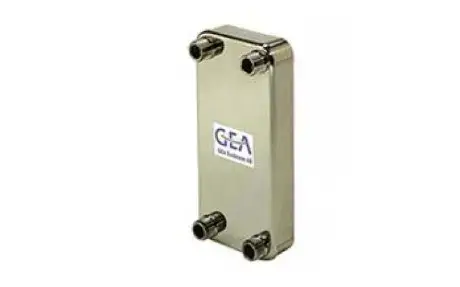
Brazed heat exchangers (PTOs) occupy a niche where classic plate devices cannot cope with pressure or aggressive media, and shell-and-tube ones are too bulky. This is not just an alternative, but a specialized solution for compact systems with high parameters. The design of such a device is fundamentally different from its collapsible counterparts. Here, the plates are not bolted together, but soldered into a monoblock in a vacuum furnace at a temperature of about 900-150 °C. Copper or nickel alloy act as solder, creating sealed seams between the rows of plates. This technology allows a pressure of up to 1.6 MPa to be achieved, whereas standard plate heat exchangers are usually limited to 2.5 MPa.
Design features and compactness
The design defines the possibilities. The packing density of the plates in the soldered module reaches 300-400 plates per unit, which gives a huge heat exchange area with minimal dimensions. The weight of the device with a mass of 1 m2 of heat exchange area is only 25-30 kg. For comparison, a shell-and-tube analog of the same power will weigh 5-7 times more. Compactness is critical for upgrading existing systems where space on the site is limited. In this case, the resource of the solder joint depends on the quality of the solder and the purity of the alloys of the plates. 316L stainless steel or titanium is used for the plates, and copper is used for solder. This combination provides corrosion resistance and high thermal conductivity of the joint.
Temperature limits and materials
Temperature limits dictate the scope of application. The operating temperature of liquids in brazed heat exchangers varies from -50 °C to +250 °C. The maximum temperature of 150 °C is reached when using nickel solder instead of copper. Copper solder begins to lose strength already at 200 ° C, therefore, nickel is used for steam systems or hot media above this mark. The pressure drops to 1.6 MPa. If the task is cold water or refrigerants, then the copper solder can withstand up to 4.5 MPa at temperatures up to 150 °C. The temperature differences between the supply and return should not exceed 30-40 °C in one pass to avoid thermal stresses in the seams. Cyclic fluctuations, for example, the sudden inclusion of steam in a cold circuit, lead to microcracks after 2-3 years of operation.
The choice of plate material depends on the environment. Stainless steel is used for heating and hot water supply systems. For offshore installations or chemical industries — titanium. Titanium plates have a density of 4.5 g/cm3, which is 30% lighter than steel, but 2.5 times more expensive. The thermal conductivity of copper solder is 380 W/(m·K), which is 4 times higher than that of stainless steel. This means that the heat transfer coefficient for brazed devices with copper solder is 15-20% higher than that of plate devices with rubber gaskets. Losses