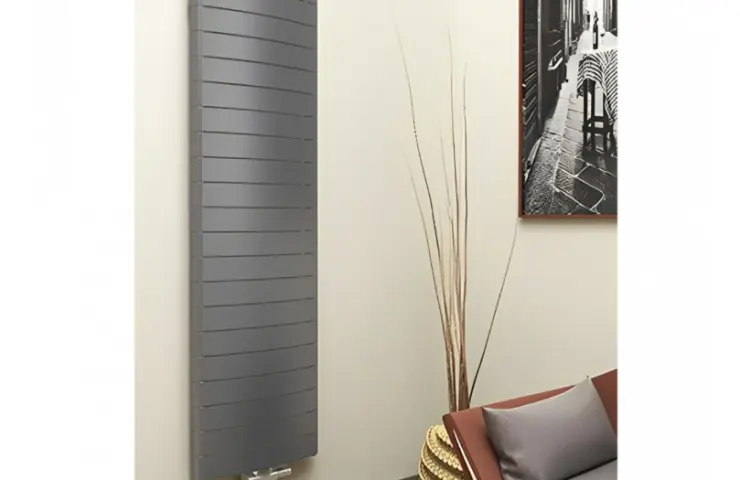
Vertical radiators for home heating are increasingly being considered by experts not as a design element, but as a full-fledged heating device that requires precise engineering calculations. With proper selection, they are able to provide a stable thermal regime even in rooms with complex geometries, high ceilings and limited space for installing classic batteries.
Thermal engineering features of vertical radiators
From the point of view of heat transfer, vertical radiators work on a combined principle — convection and thermal radiation. Due to the increased height, the proportion of natural convection increases: heated air rises along the surface of the radiator and forms a steady heat flow without local overheating.
However, the efficiency directly depends on the calculation of the heat output. For professional selection, the following factors are taken into account:
- total heat loss of a room through enclosing structures;
- ceiling height and air volume, not just area;
- temperature chart of the heating system;
- type of coolant and operating pressure.
Ignoring these parameters leads to a typical error — the radiator is visually large, but actually insufficient in power.
The effect of the material on thermal inertia and resource
The radiator material determines not only the heat transfer, but also the behavior of the system when the temperature changes. This is especially critical in autonomous systems, as the boiler can operate in variable modes.
In the middle of the article, it is important to emphasize that the radiator is cast iron https://gorodkotlov.by/catalog/radiatory/chugunnye / remains the standard for thermal inertia. Cast iron accumulates a significant amount of heat and continues heating even after the coolant circulation stops. This property is valuable for homes with solid fuel boilers where the supply temperature is unstable. In addition, cast iron is resistant to corrosion and the chemical composition of water, which reduces the requirements for the preparation of the coolant.
The technical differences of the materials are as follows:
- steel radiators react faster to temperature changes, but are less inertial.;
- aluminum models have high heat dissipation, but they are sensitive to water quality.;
- bimetallic structures can withstand high pressure and are suitable for complex systems.;
- cast iron ensures maximum service life and thermal stability.
Hydraulics and connection of vertical radiators
Vertical radiators are more sensitive to the wiring diagram than standard ones