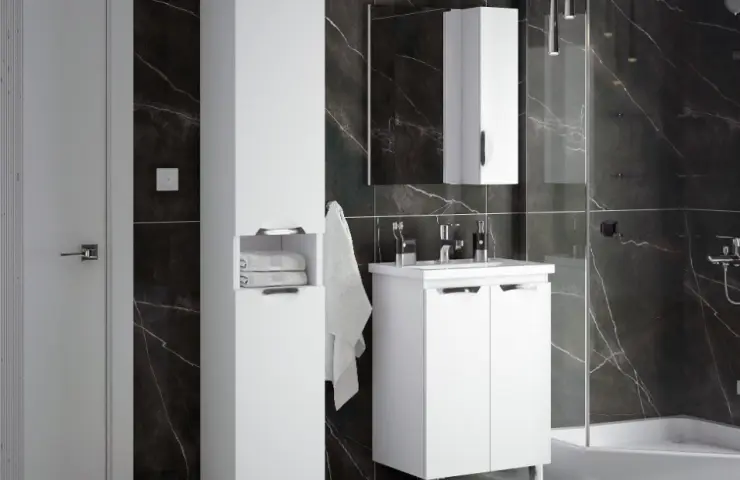
When choosing bathroom furniture, it is important to take into account not only the appearance, but also the resistance of materials to moisture and temperature changes. That is why bathroom furniture requires a more careful approach than products for living rooms.
Features of MDF in conditions of high humidity
MDF is considered a more technologically advanced material, as it is made from finely dispersed wood fibers under high pressure. This structure ensures uniformity and allows you to create complex facade shapes. This is especially true in the bathroom, as aesthetics are often combined with compact dimensions.
When using MDF in bathroom furniture, the following advantages are important:
- high density of the material, due to which it is less susceptible to swelling when in contact with moisture;
- the possibility of applying moisture-resistant coatings, including enamel and PVC film, increasing the service life;
- neat appearance with smooth edges and decorative elements;
- good maintainability in case of local surface damage.
These characteristics make MDF a popular choice for cabinets and cabinets in bathrooms.
Chipboard and its practicality
Chipboard remains one of the most affordable materials for cabinet furniture. It is a chipboard with a laminated protective layer that determines its resistance to moisture. In the bathroom, this material requires more careful operation and high-quality end treatment.
When choosing chipboard, it is worth considering the following features:
- lower cost compared to MDF, which is important with a limited budget;
- a variety of decors, allowing you to choose furniture for any interior.;
- sensitivity to damage to the laminated layer, especially at the joints;
- the need to use a moisture-proof edge to protect against water and steam.
If these conditions are met, chipboard can serve for a long time even in the bathroom.
What to choose for specific conditions
The final choice between MDF and chipboard depends on the operating conditions and the expectations of the owner. In rooms with poor ventilation and high humidity, material requirements increase. The frequency of furniture use and the expected load are also important.
MDF is more often chosen for durable and visually expressive furniture, while chipboard is suitable for simpler and more budget-friendly solutions.
Both MDF and chipboard can be used in bathroom furniture with the right approach to selection and installation. If durability and design are a priority, MDF should be preferred, and if necessary, save money.