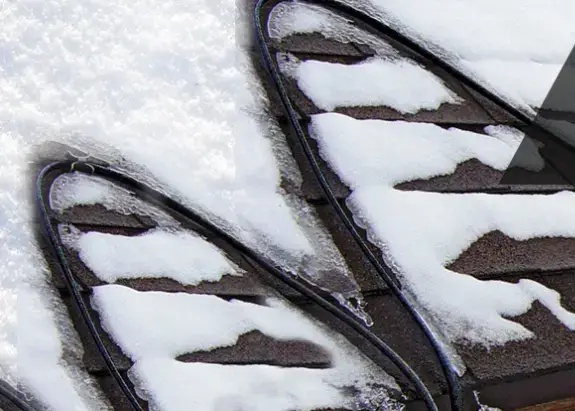
Heating of drains is not just an element of comfort, but an important measure to protect the house from winter problems. Ice, icicles, and ice in the gutters can damage the roof, facade, and even the foundation. To avoid unpleasant consequences and expensive repairs, it is worth considering the heating system in advance. Below are 10 practical tips that will help you choose and install gutter heating correctly.
1. Determine if you need gutter heating.
Before purchasing and installing the system, it is important to understand how acute the problem is. Heating is especially necessary if:
-
The house is located in a region with frequent thaws and frosts.
-
The roof has a complex configuration and large areas where snow can accumulate.
-
The drainage system is often clogged with ice.
-
Icicles appear on the roof, threatening the safety of passers-by.
If you have a single-pitched roof in a warm region, mechanical cleaning without electric heating may be enough.
2. Select the appropriate cable type
There are two main types of cables used for heating drains:
-
Resistive cable
-
It constantly emits the same amount of heat.
-
Cheaper to install.
-
You need to accurately calculate the length and power.
-
-
Self-regulating cable
-
Automatically changes the power depending on the ambient temperature.
-
It is more economical to operate.
-
It can be cut to any length.
-
For long gutter systems and complex roofs, self-regulating cable is usually preferable, although it is more expensive.
3. Calculate the power and length of the cable
Errors in calculations can lead to the fact that the system will either be insufficiently efficient or will overspend electricity. Usually, a power cable is used for gutters and pipes.:
-
20-30 W/m — for moderate climatic conditions.
-
30-40 W/m — for harsh winters.
When calculating the length, take into account:
-
The length of the gutters.
-
The number and height of downpipes.
-
The need to lay cables on the edges of the roof.
4. Install the cable in the correct areas
A common mistake is to heat only the downpipes. In order for the system to work efficiently, the cable must be laid:
-
Along the edge of the roof (cornice area) to prevent ice build-up.
-
In the gutters, so that the meltwater does not freeze.
-
Inside the drainpipes for free flow of water.
5. Use the control system and sensors
Modern heating systems can be automated using:
-
Thermoregulators