Material and construction
Steel is the main material
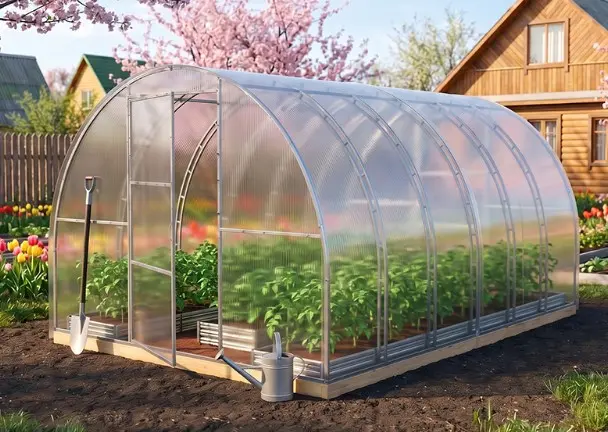
The vast majority of industrial polycarbonate greenhouses have a steel frame. Arcs, purlins (horizontal pipes along the length), and end frames are made from rectangular or square pipes. Steel provides the necessary rigidity with low weight and is affordable.
The key parameter of the steel profile is the wall thickness. Budget greenhouses: 0.8 mm. Standard: 1.0mm. Reinforced greenhouses: 1.2–2.0 mm. The difference is clearly felt physically: a profile with a thickness of 0.8 mm "springs" under load, 1.5 mm is rigid and does not give in.
Aluminum frame
It is used in expensive greenhouses — lightweight, corrosion-resistant, durable. A significant disadvantage is the price is 2-3 times higher than the steel one. Repairs are more difficult: aluminum is not brewed by home methods, the connections are bolted. It is redundant for most suburban greenhouses.
Plastic and wooden frame
Plastic (polypropylene pipes or fittings) is used in budget seasonal greenhouses. It is not used for stationary greenhouses due to insufficient rigidity. Wooden frame — for self-construction and environmental projects. It requires regular antiseptic impregnation, is afraid of moisture and insects.
Greenhouse frame materials and their comparison:
-
Galvanized steel: the best choice for industrial greenhouses — tough, durable, affordable.
-
Painted steel: affordable, with a service life of 5-7 years with continuous operation.
-
Aluminum: durable and lightweight, but expensive — for expensive structures.
-
Plastic and wood: for seasonal greenhouses and self-construction, not for industrial greenhouses.
Which profile is better for a polycarbonate greenhouse
The cross section of the profile determines the bending stiffness of the frame. A rectangular tube of 20×40 mm is standard for most greenhouses. Pipes of this section are sufficiently rigid and flexible enough to form arcs of the required radius. Reinforced greenhouses use a 25×50 mm or 20×40 mm profile with a thicker wall. A 20×20 mm square tube is suitable for lightweight, compact structures without high load requirements.
The wall thickness of the profile is the most important strength parameter. A manufacturer who says "reinforced greenhouse" but does not name the thickness of the profile raises reasonable doubts. Ask for specific numbers: 0.8 mm — budget; 1.0 mm — standard; 1.2–1.5 mm — reinforced; 2.0 mm — maximum strength.
Profile protective coating: hot-dip galvanized vs. painted — the difference in service life in an aggressive greenhouse environment is 10-15 years. This is a key selection parameter along with the wall thickness.
Parameters