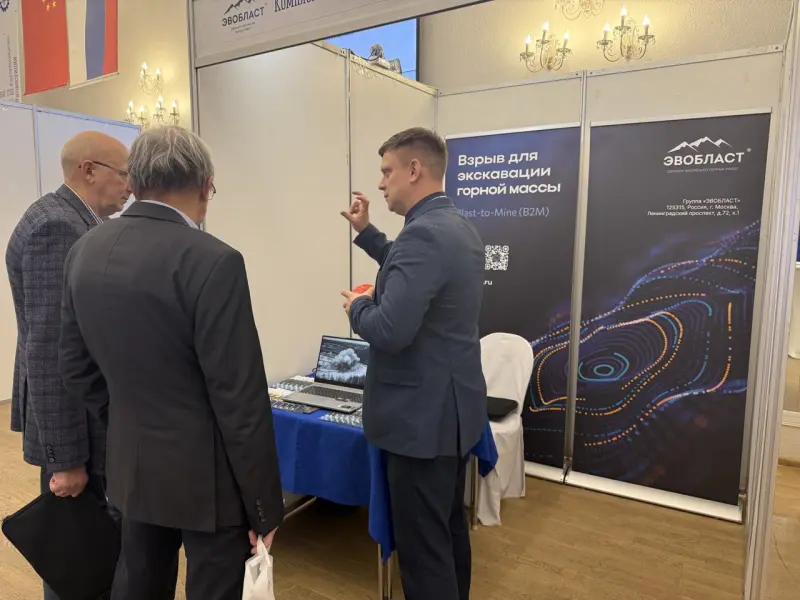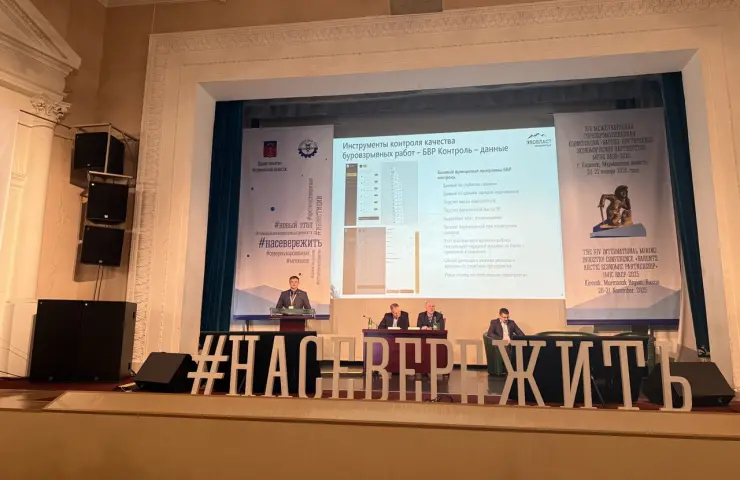
The EVOBLAST Group participated in the International Mining Conference "Barents-Arctic Economic Partnership" (MGPC BAEP 2025), which was held in Kirovsk, Murmansk region. The company sponsored the event and also presented its own solutions to improve the efficiency of drilling and blasting operations, including in the harsh conditions of the region.
The conference is being held in Kirovsk for the fourteenth time and is one of the key industry platforms in the Arctic zone of the Russian Federation, bringing together specialists in the extraction and processing of solid minerals, scientific institutes, manufacturers and suppliers of solutions for subsurface users. The key vectors are the development of domestic technologies, increasing the complexity of the use of mineral resources and the formation of new cooperative ties.
As part of his presentation "A set of innovative technologies to improve the efficiency of drilling and blasting operations", Sergey Moser, General Director of EVOBLAST Engineering, presented the company's new products to improve the efficiency and safety of blasting operations.
The key solution in the Group's product portfolio is the electronic initiation systems (ESI) of the iDet brand, which allow monitoring the operability of each detonator from the installation stage to the moment of detonation. Thanks to the built-in electronic protection, the ESI iDet eliminates the possibility of accidental or unauthorized initiation. The use of ESI minimizes seismic impact and makes it possible to carry out cascade explosions.
To monitor and operationally manage the quality of drilling and blasting operations, the EVOBLAST Group has developed the BVR Control program. The program allows data collection to monitor the implementation of drilling and blasting project decisions based on parameters such as the depth of wells, the amount of explosive in each well, as well as the working time of the mixing and charging machine.
Another solution for monitoring and monitoring is sensors for monitoring the displacement of rock mass. Sensors are installed in special software wells at the contact between ore and rock for the possibility of instrumental monitoring of losses and dilution of rock mass during explosive loosening. The sensors can be used in extremely low temperatures from -45 °C. The depth of the sensor search is up to 15 meters, depending on the lithotype of the rocks, and the standby time is 31 days.
Technologies