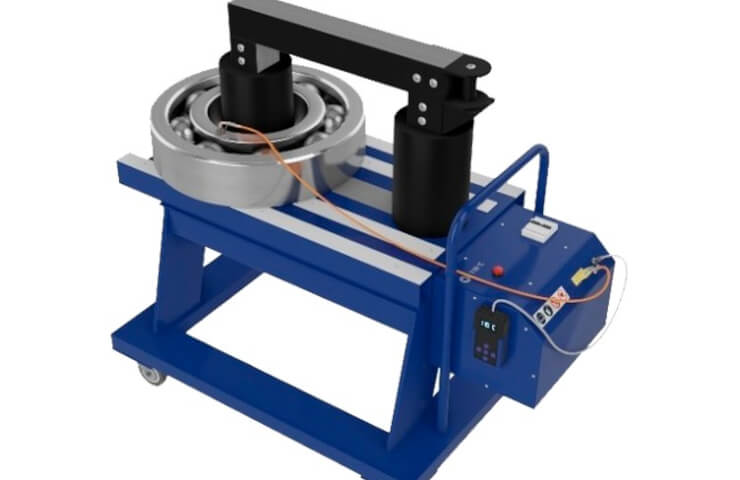
In industrial practice, heating metal parts is a key process in operations such as bearing fitting, soldering, heat treatment, and forging. Traditionally, muffle furnaces, heating elements and gas burners are used for this purpose. However, with the development of technology, induction heating is becoming increasingly popular, a method based on the generation of eddy currents inside a metal due to the action of an alternating magnetic field.
Modern induction heaters allow you to achieve high speed, accuracy and safety of the process. This makes them not only an actual alternative to the old methods, but also a technological standard in a number of industries. In this article, we will compare the efficiency of induction heating with the most common traditional methods.
Comparison with heating elements, muffle furnaces, burners
Let's look at the main features and disadvantages of the most popular traditional solutions.:
1. Heating elements (tubular electric heaters)
-
Principle of operation: heating of air or metal housing by passing current through a resistive element.
-
Advantages: low cost, simplicity.
-
Disadvantages:
-
Long-term exposure to operating temperature (10-30 minutes);
-
Uneven heating of the part;
-
Strong thermal radiation and overheating of the housing;
-
High inertia — it is difficult to stop heating quickly.
-
2. Muffle furnaces
-
Principle of operation: heating of the inner chamber using heating elements or ceramic elements, then the heat is transferred to the parts through the air.
-
Advantages:
-
The possibility of heat treatment of several parts at the same time;
-
Wide temperature range.
-
-
Disadvantages:
-
Very high inertia — up to 1 hour of warm-up;
-
Large heat losses;
-
Bulkiness;
-
High temperature on the furnace body.
-
3. Gas burners
-
Principle of operation: heating metal with an open flame, often used during soldering or disassembly.
-
Advantages:
-
Mobility;
-
High temperature.
-
-
Disadvantages:
-
Risk of fire and burns;
-
The inability to accurately control the temperature;
-
Contamination of the heating zone by gorenje products;
-
Uneven impact.
-
4. Induction heating
-
Principle of operation: generation of eddy currents inside a conductive material without physical contact.
-
Advantages:
-
High heating speed (10-60 sec.);
-
Uniform heating of the volume;
-
Instant on and off;
-
Absence
-