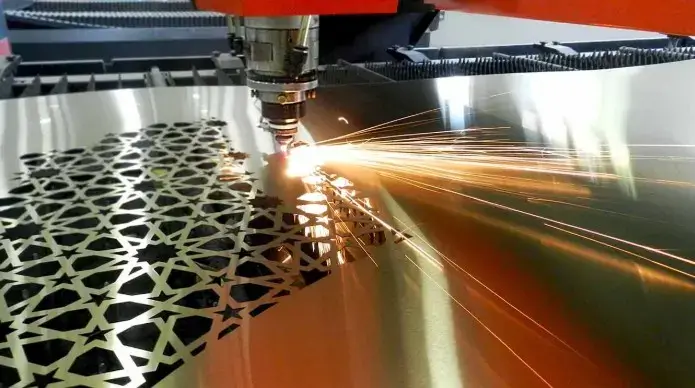
Laser cutting of metal is one of the most advanced technologies in the field of industrial materials processing. It is actively used in mechanical engineering, construction, aerospace and medical industries, as well as in the manufacture of furniture and advertising products. Due to its high precision, speed and versatility, laser cutting has gained a strong position in the market as an alternative to mechanical, plasma and waterjet cutting methods.
The technology is based on the use of a powerful laser beam that focuses on a small area, heating the metal to a melting point or evaporation. After that, the melt is removed by a jet of gas (usually nitrogen, oxygen or air), forming a neat and clean incision. Laser cutting can be automated and programmed for the most complex shapes, which makes it particularly attractive for mass production and custom manufacturing of parts.
However, despite the obvious advantages, this technology has certain limitations. To objectively evaluate its effectiveness, it is necessary to consider both the pros and cons of laser metal cutting.
Precision and edge quality
One of the main advantages of laser cutting is its unprecedented precision. The laser beam can be focused to a size of less than 0.1 mm, which allows you to achieve jewelry precision when creating even the most complex contours.
Advantages in accuracy:
-
Minimum margin of error
Unlike mechanical methods, laser cutting does not involve contact of the cutting tool with the material. This eliminates deformations and fluctuations that can lead to deviations from the set dimensions.
-
Perfectly smooth edge
The edges after laser cutting, as a rule, do not require additional grinding or processing. This is especially important in decorative and aesthetically significant products.
-
The ability to work with small parts
Even when cutting the smallest elements, a clear geometry with smooth edges is achieved.
-
Absence of burrs and scale
The purity of the cut is especially important in the manufacture of parts where subsequent welding, painting or powder coating is required.
This precision makes laser cutting indispensable in the manufacture of electronics, medical instruments, thin housings and highly repeatable parts.
Speed and performance
Laser cutting is not only accurate, but also highly productive. Modern fiber lasers are capable of cutting thin sheets of metal at speeds unattainable by most alternative methods. At the same time, automation of the process minimizes operator involvement and