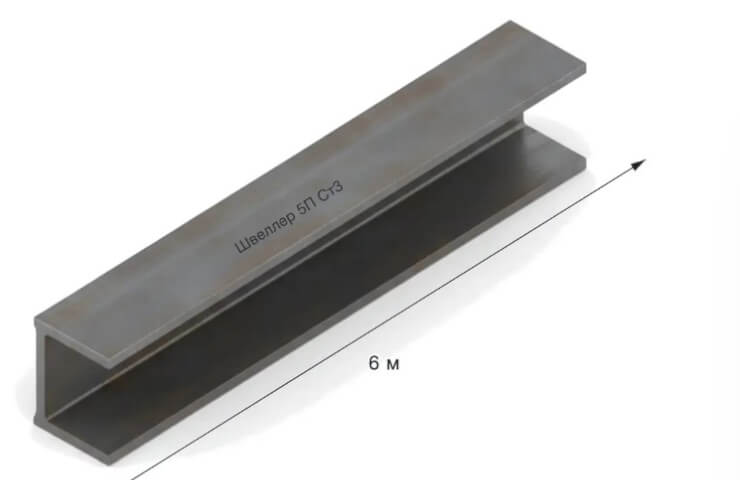
"Channel 12, ten tons" — from the point of view of the supplier, the application is exhaustive. From the point of view of GOST 8240-97, no: the U, P, E and L series are behind the twelfth number, and next to it in the price lists there is also a bent channel according to GOST 8278, which is generally a different profile. The difference comes up already at the installation.
Where did the bias come from
The classic channel of the U series is the heir to the old rolling mills: the inner edges of the shelves go at a slope of 4-10%, the shelf thickens to the wall. For the metal itself, this is not bad — the cross-section at the root of the shelf works with a margin.
The problems start with fasteners. The bolt, tightened on an inclined shelf, stands crookedly; in order for the connection to work, an oblique washer is placed under the nut according to GOST 10906. Forgotten oblique washers are a classic technical supervision remark on bolted assemblies.
The P-series closes this topic: the edges of the shelves are parallel, the fasteners are placed directly, the nodes are simpler and cheaper to assemble. Therefore, in new KM, designers almost always lay it down.
Is it possible to change the series among themselves
Formally, the same series number Y and N have similar moments of resistance, and in terms of strength, the replacement most often takes place. But it's not strength that decides.:
- if the bolted nodes in the project are painlessly replaced with U, the reverse replacement leads to oblique washers and questions from supervision.;
- economical E and light L with the same number have a thinner wall and shelf — they cannot be replaced with U or N without recalculation.;
- welded assemblies are indifferent to the slope, there the series are really almost equivalent.
The general rule is the same as for any beam: the replacement is confirmed by the designer. The number is the height of the profile in centimeters, and the channel above the design one may simply not fit into the node.
Bent is a separate story
The bent channel according to GOST 8278-83 is made on roll forming mills from a sheet. It has rounded corners, a thin wall and a noticeably lower load-bearing capacity for the same size. It costs less and weighs less — because of this, they regularly try to put it instead of hot-rolled "to save money."
In fences, frames, gate frames — please. In the carrier circuit calculated according to GOST 8240, there is no, period. This is not a matter of taste, these are different design characteristics.
Availability and acceptance
The running numbers are from the 8th to the 20th, the U and P series are kept in parallel, large 24-40 are more often delivered to order. From the practice of the St. Petersburg market: warehouse suppliers like TD InvestMet have both series of serial numbers all the time, so it makes sense to write the letter of the series directly when ordering — then the question of replacement does not arise at all.
Three things are considered during acceptance: the grade of steel in the certificate (St3sp/ps, for critical structures C255 and higher), the curvature — no more than 2 mm per meter, and the letter of the series on the package tag. Mixed up