Modern industry requires constant updating of production facilities, the introduction of innovative technologies and modern high-performance equipment. Each company strives to increase its competitiveness by reducing costs and increasing the volume of high-quality products. One of the most important aspects is equipping production facilities with equipment that can effectively solve production tasks, including the processes of crushing, crushing and processing of various materials.
Crushers are one of the most popular types of equipment. These are special devices designed to crush large particles of raw materials to the required size, which are then used in technological processes or in the production of the final product. The use of crushers is relevant in almost all industries, from the mining sector to the food industry.
However, the choice of a specific crushing plant model depends on many factors, including the nature of the material being processed, requirements for the final product, operating conditions, and more. That is why there is a wide variety of types of crushers, each of which has its own design features and scope of application.
Among the wide variety of existing solutions, special attention should be paid to hammer crushers, which are characterized by high productivity and efficiency in the crushing of various materials.
The principle of operation and purpose of hammer crushers
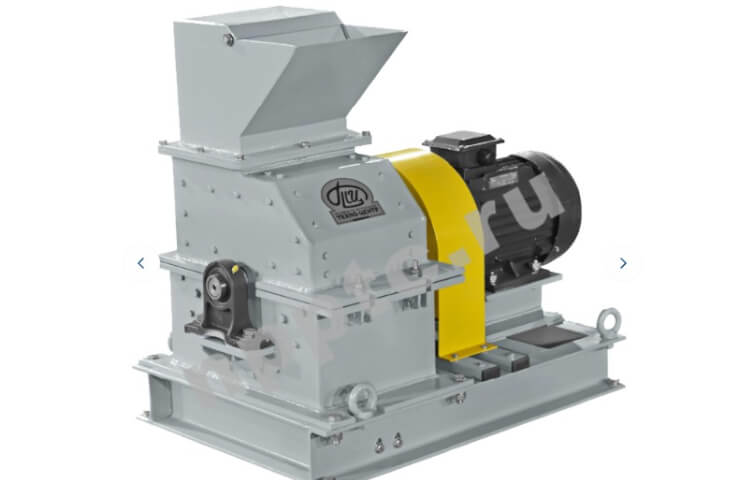
The hammer crusher is an installation designed for crushing brittle large, medium and small materials by impact and abrasion. Its design includes a rotor with special hammers mounted on it, rotating around a central axis. The raw material is fed into the crushing chamber, where it is subjected to intense hammer blows, which lead to the destruction of material particles into small fractions of a given size.
Such machines are widely used in various fields of industrial production, such as coal mining, metallurgy, construction, agriculture and the chemical industry. They are capable of processing a wide range of materials: limestone, gypsum, clay, graphite and other types, providing high productivity and efficient crushing of raw materials.
The features of hammer crushers include a convenient collapsible design, the manufacture of parts from wear-resistant steels, the presence of protective covers, a special device for the loading nozzle, the ability to rotate the hammers and automatic protection against breakage. These design solutions ensure reliable operation, high