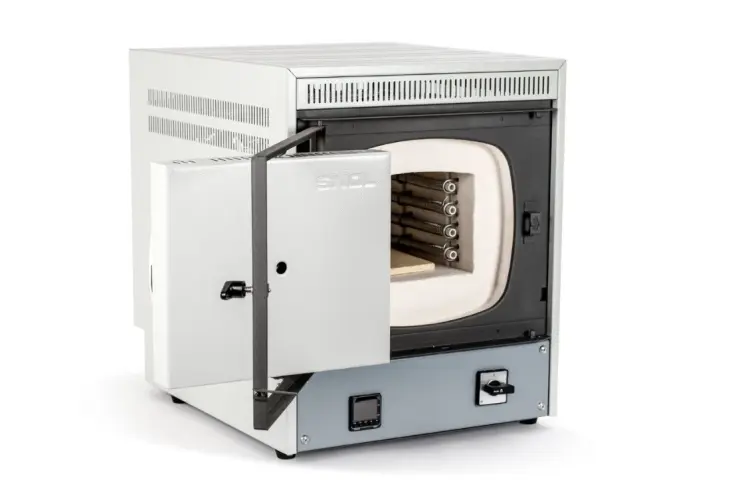
Laboratory furnaces are specialized equipment designed to carry out high-precision thermal processes in scientific, industrial and research laboratories. The Exiton-Test catalog presents various models of laboratory furnaces that can meet the needs of both universal laboratories and specialized industries.
Laboratory furnace of snow
One of the most popular models in the range of laboratory equipment is the SNOL laboratory furnace, a universal solution for heat treatment of materials in scientific and industrial laboratories. This model combines modern design, precise temperature control and extensive operational capabilities, making it optimal for tasks of varying complexity. The furnaces of the SNOL series are distinguished by high-quality thermal insulation, which ensures a stable temperature regime and minimal heat losses, as well as a well-thought-out control system that allows you to set accurate heating and holding programs. Thanks to these characteristics, SNOL confidently handles both simple drying and sterilization tasks, as well as more complex operations, such as testing materials at preset temperature cycles. Reliability, durability and ease of operation make the SNOL laboratory furnace a sought-after choice for university, research and industrial laboratories.
Main applications of laboratory furnaces
Laboratory furnaces are used for a number of technological operations that require precise temperature control. The main directions are given below:
- Drying and dehydration is the removal of moisture from samples, materials, and laboratory utensils for subsequent analysis or preparation for processes.
- Dry heat sterilization is the destruction of microorganisms on glassware and instruments by heating to temperatures at which biological contaminants lose their activity.
- Heat treatment and annealing are changes in the physical properties of materials, for example, improving plasticity or relieving internal stresses.
- Material testing is the study of the behavior of samples when exposed to temperatures, which is important in materials science and product standardization.
Such processes are widely used both in scientific and technical research laboratories and in industrial test centers. The high precision of temperature control allows for stable and reproducible results.
Modern units are equipped with precise digital controls, programmable controllers and safety systems, which allows