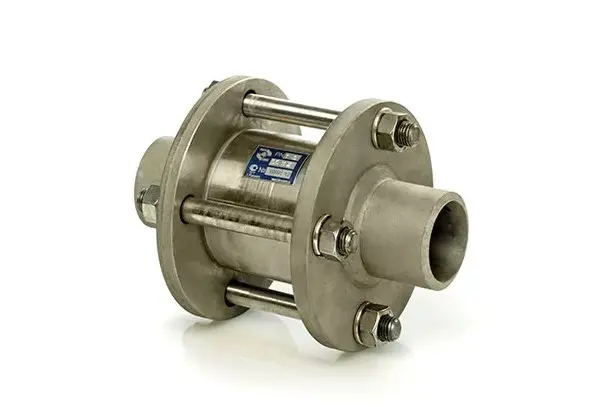
Trouble-free operation of industrial pipelines requires the use of specialized fittings. One of the key protective devices is a non-return pipeline valve. Its main function is to allow the flow of the working environment in only one direction. This prevents the reverse movement of liquid or gas, which can lead to an accident.
Operating principle and purpose of the device
The principle of operation of this device is based on automatic operation. Under the pressure of the flow, the gate (spool, plate or ball) opens, allowing the medium to pass freely. As soon as the pressure drops or a reverse flow occurs, the gate closes under the influence of its own weight or a return spring. Therefore, it blocks the passage section of the pipeline.
The non-return pipeline valve solves several critical tasks. First of all, it protects the pumping equipment from working in the opposite direction, which prevents it from breaking down. In addition, it does not allow mixing of different media from parallel lines. Therefore, its installation is necessary to ensure the safety and stability of the technological process.
Constructive varieties and their application
The design of the pipeline check valve may vary depending on the operating conditions. There are two main types: lifting and turning. In lifting models, the shutter moves vertically, and in rotary models it reclines around the axis. There are also ball and flanged models that are compact.
The choice of a specific type depends on the system parameters. Rotary valves are well suited for systems with low flow rates and large pipe diameters. Lifting models equipped with a spring are effective in any position and on pipelines with pulsating flow. Flanged check valves are often installed in areas with limited space.
Key aspects of installation and maintenance
Proper installation directly affects the device's performance. Installation is performed on horizontal or vertical sections of the pipeline, taking into account the flow direction. It is always indicated by an arrow on the valve body. A filter is usually installed in front of it to protect the seat and gate from abrasive particles.
Maintenance consists of periodic health checks. To do this, make sure that there are no extraneous noises, vibrations and leaks through the seals. In case of contamination, the internal components need to be cleaned. Thus, regular inspection guarantees a long service life and reliable protection of the system.
The check valve is an indispensable element of the industrial pipeline system.