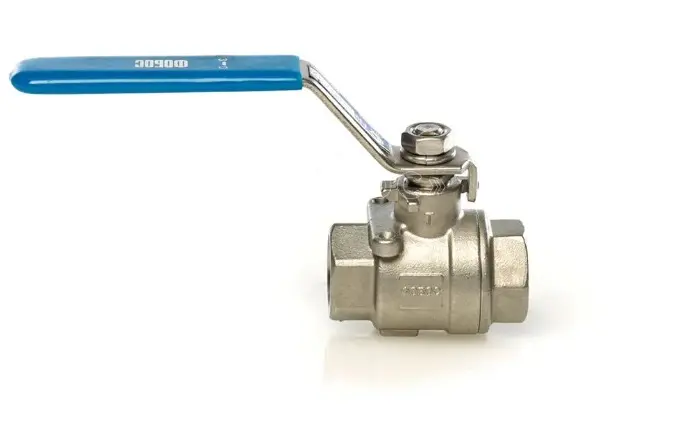
In industrial pipeline systems, the reliability of each connection directly affects the safety and continuity of technological processes. Among the variety of shut-off valves, the ball valve remains one of the most sought-after solutions for stationary lines. Its popularity is due to the simplicity of its design, high tightness and relatively low cost. These devices effectively block the flow of liquid or gas in systems with different parameters.
Design and operating principle of the coupling crane
The key feature of this type of valve is the threaded coupling connection. The internal thread at both ends of the housing allows the tap to be directly screwed into the pipeline. The main structural elements are a cast or forged body, a ball valve with a cylindrical channel, sealing seats and a rotating spindle. The control is carried out by a handle that rotates the ball by 90 degrees. Therefore, the passage either opens completely or is blocked.
The materials of manufacture are selected for specific operating conditions. Carbon steel and brass are often used for non-aggressive media and moderate pressures. Stainless steels and special alloys are used to work with chemically active substances or at high temperatures. Seals made of fluoroplast or other polymers provide the necessary tightness and wear resistance. Therefore, the right choice of materials is critically important for the durability of the node.
Main advantages and possible limitations
The use of a ball valve provides a number of significant advantages in industry. First of all, it is a high degree of tightness in the closed position. Modern models comply with class "A" according to GOST, completely eliminating leaks. In addition, such a connection is compact and does not require additional elements for installation. This allows you to save space in dense communication schemes.
Another advantage is the simplicity of the design and, as a result, reliability. The device has a minimum number of moving parts. This reduces the risk of breakage and simplifies maintenance. On the other hand, the coupling connection has certain limitations. It is difficult to dismantle it without stopping the entire line, especially after prolonged operation. Also, a threaded connection may be less resistant to strong vibrations compared to a welded or flanged one. Therefore, such cranes are more often used in stationary, non-collapsible areas.
Areas of industrial application
Due to their characteristics, coupling ball valves are widely used in various industries. In water supply and heat supply systems, they serve